Office Fitouts Sydney: Your Complete Guide
Last updated:
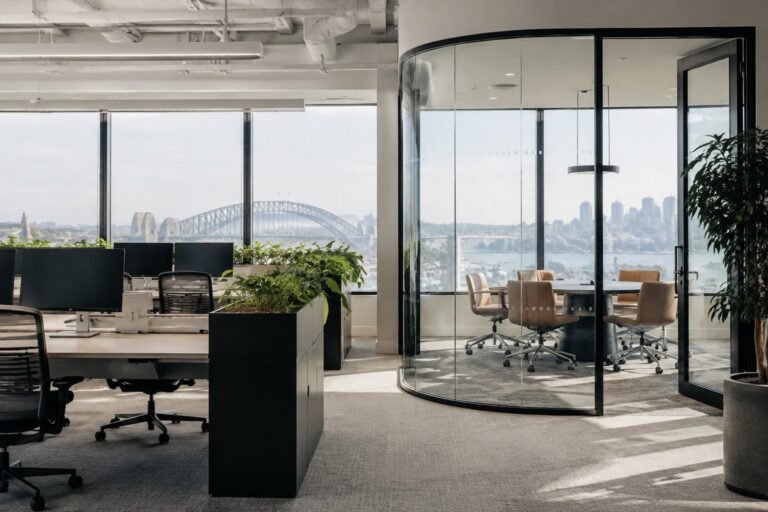
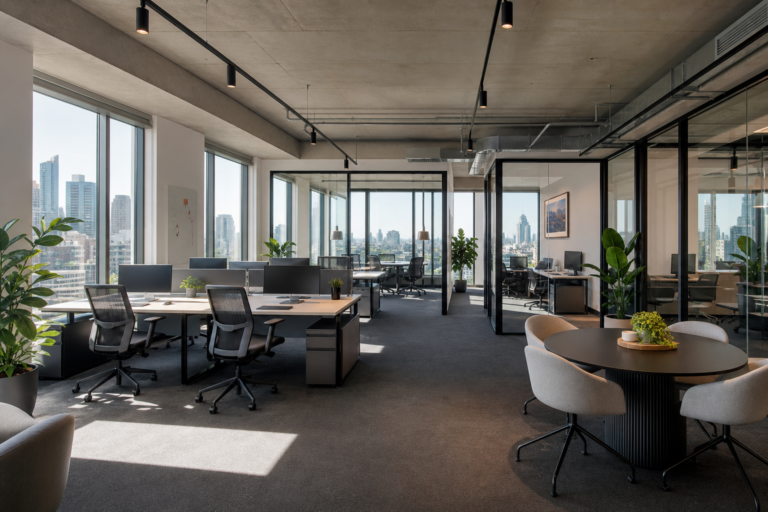
Office fitouts Sydney cover every stage of transforming a bare or outdated commercial space into a functional, brand-aligned workplace — from initial space planning and design through to construction, furniture installation, and final handover. Whether you are relocating to a new tenancy in the CBD, upgrading an ageing office in Parramatta, or expanding into a second floor in North Sydney, a professional office fitout delivers the layout, services, and finishes your team needs to work at its best. Office Fitouts Sydney specialises in end-to-end fitout solutions for businesses of every size across the greater Sydney metropolitan area.
This guide explains what an office fitout actually involves, breaks down current costs and timelines, covers the latest design trends shaping Sydney workplaces in 2026, and walks you through the step-by-step process so you can plan your project with confidence.
What Are Office Fitouts and Why Do They Matter?
An office fitout is the process of making a commercial interior space suitable for occupation. It goes well beyond a fresh coat of paint. A full fitout encompasses spatial planning, partitioning, mechanical and electrical services (HVAC, lighting, data cabling), flooring, joinery, furniture procurement, and compliance certification.
For Sydney businesses, the quality of your workspace directly impacts three things: employee productivity, talent attraction, and client perception. Research consistently shows that well-designed offices reduce absenteeism, improve collaboration, and contribute to higher staff retention — critical factors in Sydney’s competitive employment market.
The distinction between a fitout and a renovation matters. A fitout typically starts from a base building or “warm shell” condition, while an office renovation modifies an existing finished space. Many Sydney projects involve elements of both, particularly when businesses take over a previously tenanted floor.
Types of Office Fitouts Sydney Businesses Choose
Not every fitout is the same. The scope and budget depend on what you are starting with and what your organisation requires. Here are the main categories:
Category A (Cat A) Fitout
A Cat A fitout brings a shell space to a basic lettable standard. This typically includes:
- Raised access flooring
- Suspended ceiling grid with integrated lighting
- Basic HVAC distribution
- Fire detection and sprinkler systems
- Common area finishes
In Sydney, landlords often deliver Cat A as part of the lease agreement, but not always — check your heads of agreement carefully.
Category B (Cat B) Fitout
A Cat B fitout is where your workspace becomes truly yours. This layer includes:
- Partitions and meeting rooms (glass, solid, or acoustic)
- Bespoke reception and breakout areas
- Workstation layout and furniture
- Branding, signage, and feature walls
- IT infrastructure, AV systems, and data cabling
- Kitchen and amenities fit-out
The vast majority of office fitouts Sydney businesses commission fall into this category. It is where the design decisions happen and where budget control matters most.
Turnkey Fitout
A turnkey fitout is a single-contract solution where one company manages everything — design, approvals, construction, furniture, and technology — then hands you the keys to a move-in-ready office. This approach reduces coordination risk and is increasingly popular among time-poor Sydney businesses.
Office Fitout Costs in Sydney: What to Budget
Cost is usually the first question. Here is what Sydney businesses can realistically expect to pay in 2026, based on current market rates:
Cost Per Square Metre Breakdown
| Fitout Level | Cost Per m² (ex. GST) | What’s Included |
|---|---|---|
| Basic / Budget | $600 – $900 | Paint, carpet tiles, basic partitions, standard lighting, minimal joinery |
| Mid-Range | $900 – $1,500 | Glass partitions, quality flooring, custom joinery, upgraded HVAC, branding elements |
| Premium / High-End | $1,500 – $3,000+ | Architectural features, premium materials, smart building tech, bespoke furniture, full AV integration |
For context, a 300 m² mid-range fitout in Sydney’s CBD would typically fall between $270,000 and $450,000 excluding GST. According to JLL’s 2025 Asia-Pacific Fit-Out Cost Guide, the average moderate-quality CBD office fitout in Australia sits around $3,220 per square metre when factoring in professional fees, which places Sydney at the higher end nationally.
Factors That Influence Your Fitout Cost
- Location: CBD buildings typically cost 15–25% more than suburban Sydney due to access restrictions, loading dock limitations, and after-hours work requirements
- Building age: Heritage or older buildings often require additional structural work, asbestos remediation, or service upgrades
- Design complexity: Custom joinery, curved glass, acoustic treatments, and integrated technology all add cost
- Existing condition: A bare shell costs more to fit out than modifying an existing tenancy
- Timeline: Accelerated programs increase costs due to overtime labour and expedited procurement
- Sustainability targets: NABERS or Green Star requirements may add 5–10% but deliver long-term operational savings
The Office Fitout Process: Step by Step
Understanding the process removes uncertainty. Here is how professional office fitouts in Sydney typically progress from brief to handover:
Stage 1: Briefing and Needs Analysis (1–2 Weeks)
Every successful fitout starts with a detailed brief. Your fitout partner will assess:
- Current and projected headcount
- Work styles (collaborative, focused, hybrid)
- Technology and infrastructure requirements
- Brand identity and culture goals
- Budget parameters and timeline constraints
- Lease terms and landlord requirements
Stage 2: Concept Design (2–4 Weeks)
Designers create space plans, 3D renders, and material palettes. This stage defines the look, feel, and flow of your new workspace. Expect two to three design iterations before sign-off.
Stage 3: Detailed Design and Documentation (2–4 Weeks)
Once the concept is approved, the design team produces construction-ready documentation including:
- Architectural drawings and specifications
- Mechanical, electrical, and hydraulic engineering plans
- Furniture layouts and procurement schedules
- Fire engineering and compliance documentation
Stage 4: Approvals (2–6 Weeks)
Sydney office fitouts typically require:
- Landlord approval: Almost always required, covering design, contractors, and working hours
- Council or certifier approval: Needed for changes that affect fire compartmentation, accessibility, or structural elements
- Building certifier (BCA compliance): Ensures the fitout meets the National Construction Code (NCC)
Approval timelines vary significantly. A straightforward Cat B fitout might clear approvals in two weeks, while complex projects in heritage-listed buildings can take six weeks or more.
Stage 5: Construction (6–12 Weeks)
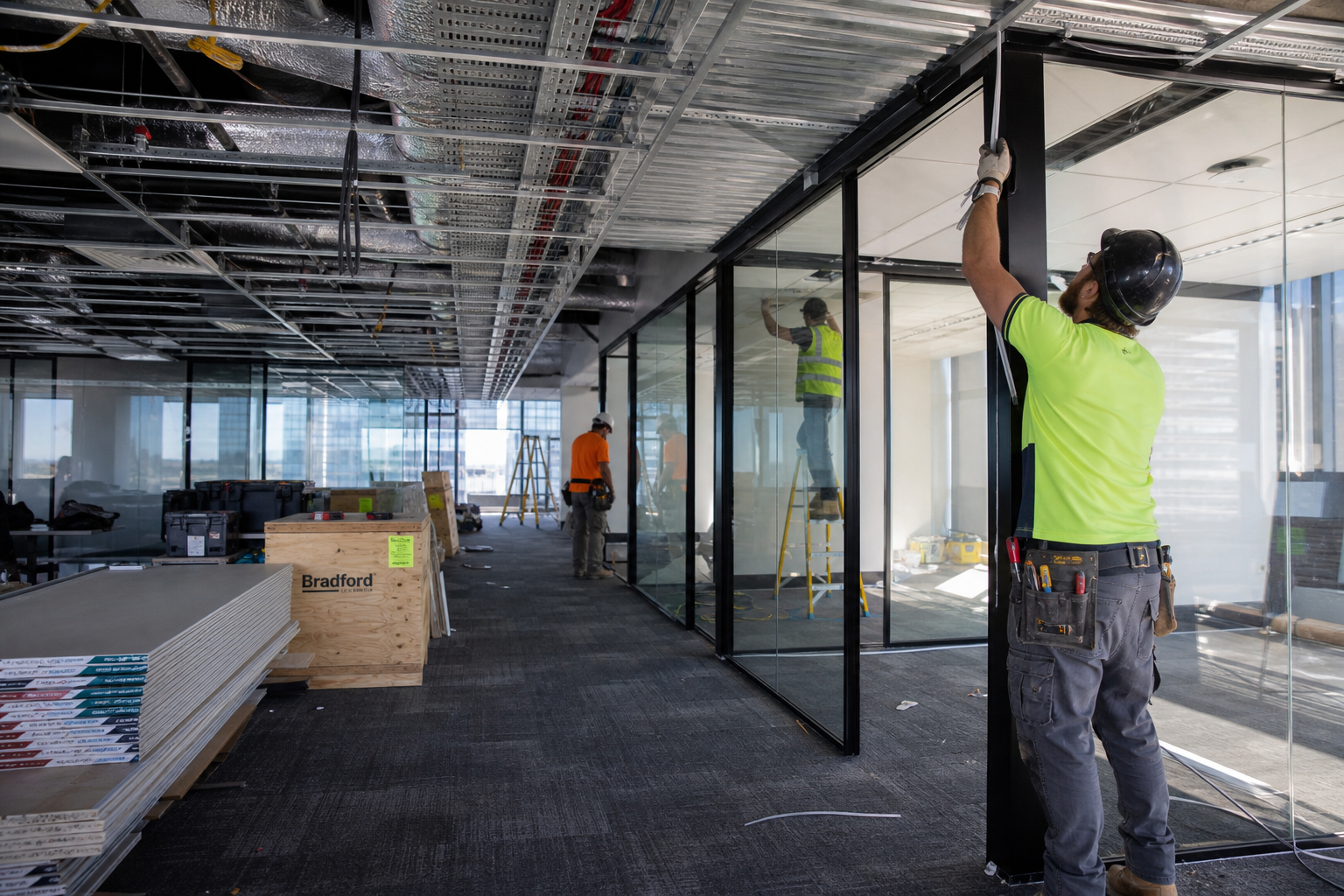
The construction phase includes demolition of existing partitions, services rough-in (electrical, data, HVAC), partition framing and glazing, ceiling installation, flooring, painting, joinery, and final fix. A well-managed fitout runs on a detailed Gantt chart with weekly site meetings and progress reporting.
Stage 6: Furniture and Technology Installation (1–2 Weeks)
Workstations, chairs, soft furnishings, AV equipment, and IT hardware are delivered and installed. This phase requires careful coordination to avoid damaging freshly completed finishes.
Stage 7: Handover and Defects Period (1–2 Weeks)
Final inspections, compliance certificates, and a formal defects walk-through. Your fitout company should provide an occupation certificate, a defects liability period (typically 12 months), and full as-built documentation.
Office Fitouts Sydney: Design Trends for 2026
Sydney’s office design landscape is evolving rapidly. Here are the trends shaping the best office fitouts Sydney businesses are commissioning right now:
Activity-Based Working (ABW)
The shift from assigned desks to activity-based zones is now standard in most corporate fitouts. ABW layouts provide a mix of focused work pods, collaborative zones, quiet rooms, and social spaces — each designed for a specific work mode. This approach typically achieves a desk-to-person ratio of 0.7:1 to 0.8:1, significantly reducing real estate costs.
Resimercial Design
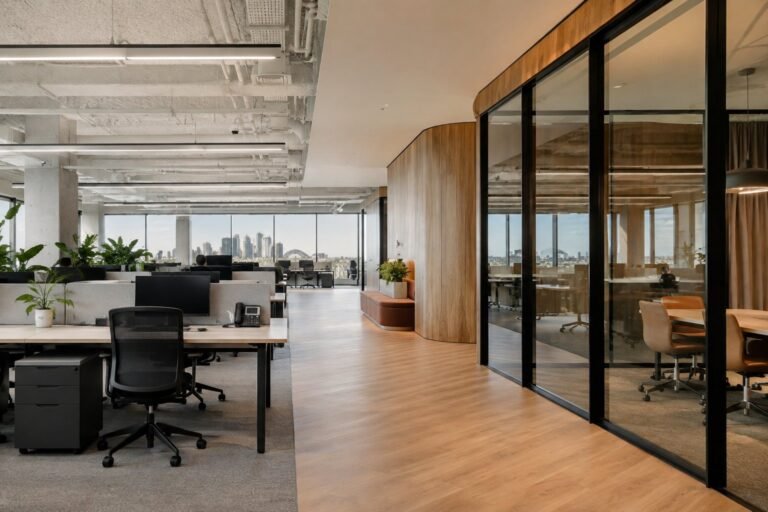
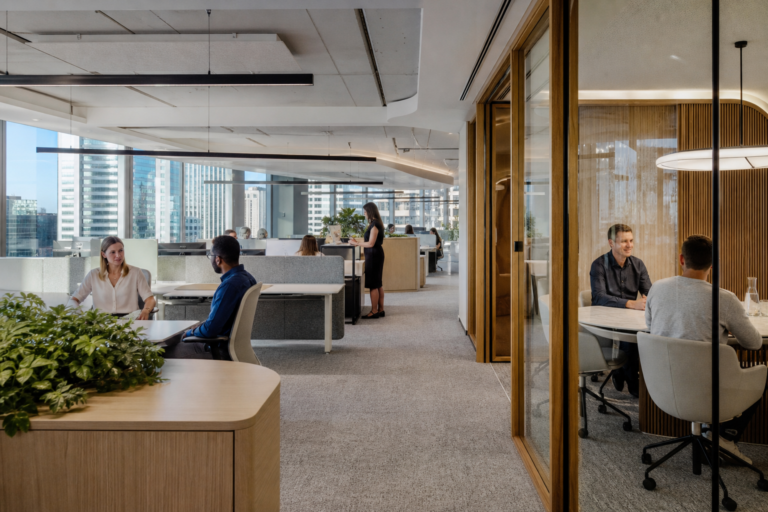
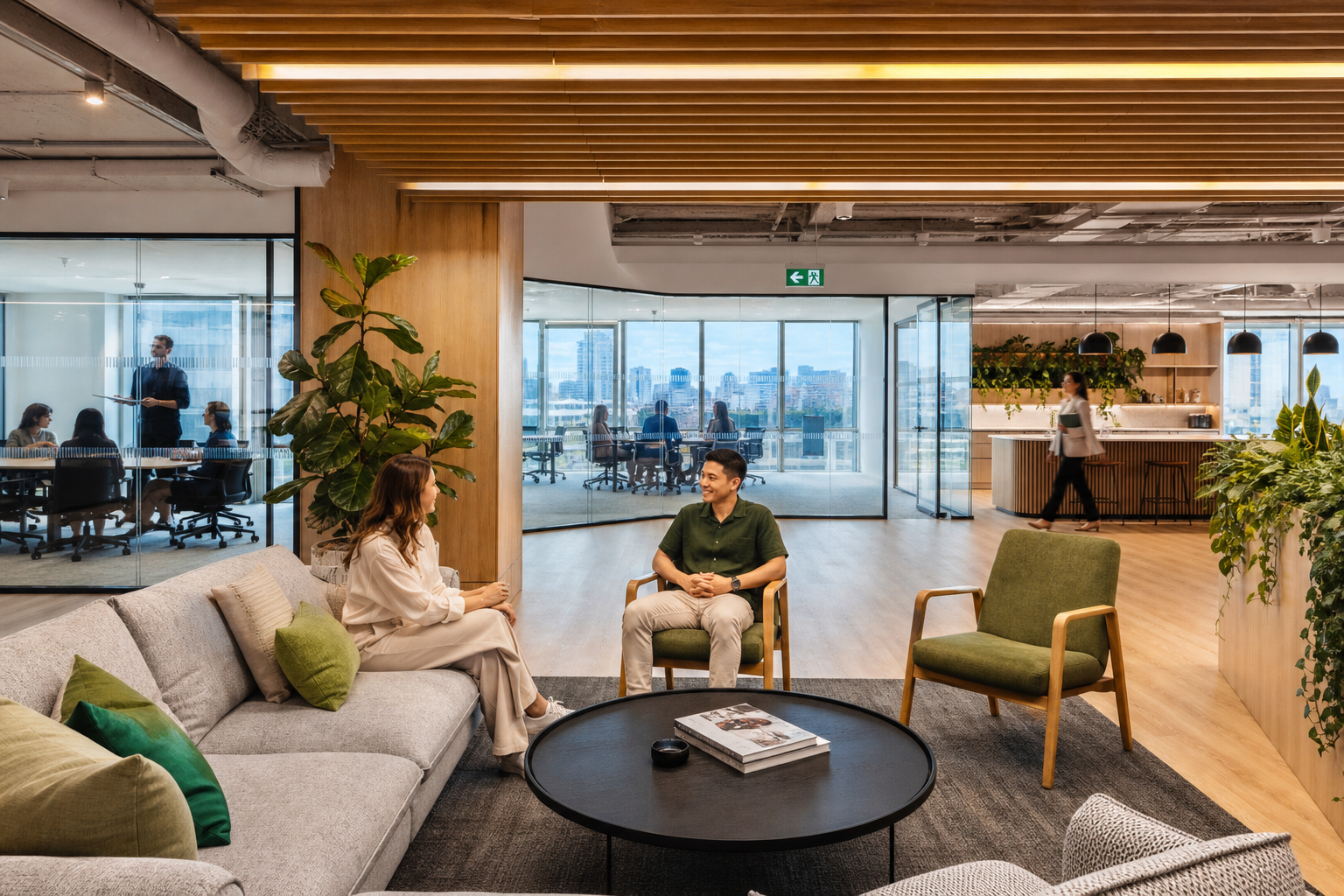
Blending residential warmth with commercial durability is one of the strongest trends in 2026. Think soft furnishings in breakout areas, timber veneers replacing hard laminate, residential-style pendant lighting, and fabric textures throughout. The goal is creating spaces that feel inviting enough to draw employees back to the office consistently.
Biophilic Design Elements
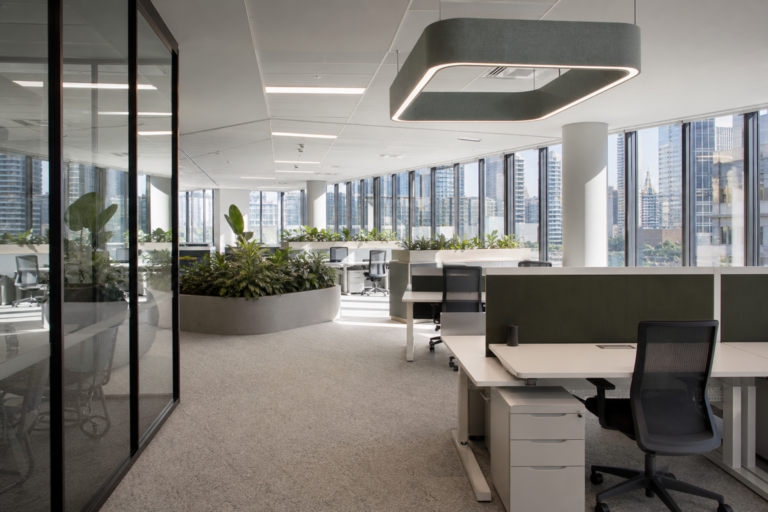
Going far beyond a few pot plants, biophilic design integrates living green walls, natural materials, water features, and maximised natural light. Studies show biophilic offices can improve productivity by up to 15% and reduce sick leave. In Sydney, where natural light is abundant, smart glazing and light-shelf systems make the most of the climate.
Acoustic Planning
With full-occupancy returning to many Sydney offices, acoustic management has become critical. Modern fitouts incorporate acoustic ceiling baffles, sound-masking systems, phone pods, and zoned layouts that separate noisy collaborative areas from focused work zones. Products are now rated by Noise Reduction Coefficient (NRC) and speech privacy standards.
Sustainability and Compliance
Under AASB S2 climate reporting requirements, Scope 3 emissions now reach into fitout decisions. Progressive Sydney businesses are specifying recycled-content flooring, low-VOC paints and adhesives, FSC-certified timbers, and energy-efficient LED systems. These choices support NABERS and Green Star targets while aligning with corporate ESG commitments.
How to Choose the Right Office Fitout Company
Selecting the right partner is the single most important decision in your fitout project. Here is what to look for:
- End-to-end capability: Companies that handle design and construction under one roof eliminate coordination gaps and finger-pointing between separate firms
- Sydney experience: Local knowledge of building regulations, council requirements, and supplier networks matters enormously
- Transparent pricing: Insist on detailed, itemised quotes rather than lump-sum estimates. Ask about provisional sums and how variations are managed
- Portfolio and references: Review completed projects similar in scale and industry to yours. Speak directly to past clients
- Project management rigour: Ask about their reporting cadence, variation management process, and how they handle delays
- Defects liability: Confirm the defects period (12 months is standard) and their process for rectifying issues post-handover
Office Fitouts Sydney brings together design expertise, construction capability, and deep local knowledge to deliver projects on time and on budget across the greater Sydney area.
Common Mistakes to Avoid With Office Fitouts in Sydney
Having seen hundreds of fitout projects, these are the errors that cost Sydney businesses the most time and money:
- Underestimating the timeline: Allow 16–24 weeks from brief to move-in. Rushing the design phase leads to expensive changes during construction.
- Ignoring lease obligations: Your lease may restrict design choices, working hours, and contractor access. Read it thoroughly before engaging a fitout company.
- Skipping the brief: A vague brief produces a vague result. Invest time upfront defining exactly how your team works and what the space needs to deliver.
- Choosing on price alone: The cheapest quote often leads to the most expensive project. Variations, delays, and poor workmanship erode any initial savings.
- Forgetting technology infrastructure: Data cabling, wireless access points, AV systems, and power provisions must be planned during design, not retrofitted after construction.
- Neglecting change management: A new office is a significant change for staff. Communicate early, involve key people in design decisions, and plan orientation sessions.
Frequently Asked Questions About Office Fitouts Sydney
How much does an office fitout cost in Sydney?
A basic office fitout in Sydney costs $600–$900 per square metre, a mid-range fitout runs $900–$1,500 per square metre, and premium fitouts start from $1,500 per square metre and can exceed $3,000 per square metre for high-specification projects. These figures exclude GST and professional fees.
How long does an office fitout take in Sydney?
Most office fitouts in Sydney take 12–20 weeks from brief to move-in. Small projects under 200 m² can be completed in 8–12 weeks, while large corporate fitouts over 1,000 m² may take 20–30 weeks including design and approvals.
Do I need council approval for an office fitout in Sydney?
Not always. Cosmetic changes like painting, carpet, and furniture do not require approval. However, changes that affect fire compartmentation, structural elements, accessibility provisions, or building services typically require a Construction Certificate from a registered building certifier. Your fitout company should advise on exactly what approvals your project needs.
What is the difference between a Cat A and Cat B fitout?
A Category A fitout delivers the base building to a lettable standard — raised floors, ceiling grid, basic HVAC, and fire services. A Category B fitout personalises the space with partitions, workstations, branding, kitchen facilities, and all the elements that make it your workplace. Most tenant fitouts are Cat B.
Can I stay in my office during a fitout?
It depends on the scope. Minor refurbishments can sometimes be staged to allow partial occupation, but most full fitouts require the space to be vacated. Dust, noise, and safety regulations make it impractical to work alongside active construction. Discuss swing space or temporary accommodation options with your fitout provider.
What should I look for in an office fitout company in Sydney?
Look for a company that offers integrated design and construction, has a strong portfolio of Sydney projects, provides transparent and itemised pricing, holds appropriate licences and insurance, and offers a minimum 12-month defects liability period. Direct references from past clients are the most reliable indicator of quality.
How do I reduce office fitout costs without sacrificing quality?
Retain existing elements that are in good condition (ceiling grid, raised floor, services), prioritise spending on high-impact areas like reception and meeting rooms, use standard workstation configurations rather than fully custom designs, and engage a design-and-construct firm to eliminate margin stacking between separate design and construction contracts.
Start Your Office Fitout Project
Whether you are planning a 100 m² startup space in Surry Hills or a 5,000 m² corporate headquarters in Barangaroo, the principles are the same: start with a clear brief, choose the right partner, and invest in design that supports how your people actually work.
Office Fitouts Sydney has the experience and capability to deliver your project from concept to completion. Get in touch to discuss your fitout requirements and receive a detailed, no-obligation proposal tailored to your space, budget, and timeline.
Make Office Fitouts Sydney a preferred source in Google
One click tells Google to surface our articles more often in Top Stories, AI Overviews and AI Mode.