Office Refurbishment Services for Sydney Property Managers
TLDR; Office refurbishment in Sydney has become a strategic lever for improving occupancy, rents, and long-term asset relevance as tenant expectations shift toward hybrid work, sustainability, and higher-quality spaces. Modern refurbishment goes beyond aesthetics to include smart technology, flexible layouts, compliance upgrades, and accessibility improvements, often delivering better ROI than full rebuilds amid limited new supply. Effective projects focus on tight timeline and cost management to reduce leasing downtime and risk while future‑proofing buildings against regulatory and market change. For owners and managers, a well-planned refurbishment directly supports stronger leasing outcomes by aligning existing assets with how offices are actually used today.
Office refurbishment services are no longer just a cosmetic exercise, certainly not in Sydney. For commercial property managers, they have become a core asset strategy that directly affects occupancy rates and rental performance, with long‑term building relevance shaping decisions made under tight timelines. Higher vacancy levels point to changing tenant expectations, often shaped by how people actually work today. With limited new office supply coming online, pressure is building to reposition existing assets through smart, well‑managed commercial renovation projects. In that setting, office refurbishment services sit between design, construction management, compliance, and leasing strategy (that mix is often unavoidable). No exceptions, in my view.
This guide is written for Sydney‑based property managers and asset owners dealing with that reality. It is clear‑eyed and practical (and deliberately grounded). The content looks at the market conditions driving refurbishment demand, explains what a modern office refurbishment Sydney project usually involves, and sets out how to manage risk and timelines while keeping compliance in view. It also looks at where future‑focused upgrades, such as sustainability and hybrid work design, fit into real projects, so attention stays on outcomes rather than theory, which usually matters more in practice.
Why Office Refurbishment Has Become a Strategic Priority in Sydney
Sydney’s office market has shifted sharply in recent years, and the biggest change isn’t pricing pressure, it’s where competition now sits. With vacancy elevated, especially across mid-grade assets, landlords are being pushed to compete on quality rather than discounts. Refurbishment has become the most effective option, largely because it can reposition buildings quickly without the heavy cost of new construction. It’s faster, more flexible, and, for many owners right now, the practical path forward.
| Metric | Value | Period |
|---|---|---|
| Sydney CBD vacancy rate | 14.3% | Dec 2025 |
| Premium-grade vacancy | 9.8% | Q3 2025 |
| Refurbished office stock delivered | 73,000 sqm | H1 2025 |
| Forecast net absorption | ~2.0 million sqm | 2026 |
Cushman & Wakefield continues to point to flight-to-quality as the main leasing trend. Tenants are consolidating into fewer locations and are consistently choosing better-designed workplaces that justify the commute and support collaboration. That expectation now drives leasing decisions more than incentives ever did, quality can’t be skipped in real terms.
The flight to quality trend continues, with occupiers taking advantage of reduced net effective rents compared to the same time last year. The market is on track to record gross take-up of close to 1.2 million sqm in 2025, which remains above the long-term average.
For property managers, this means office refurbishment services are no longer optional. They’re practical tools for reducing downtime and protecting rents, especially around lease events. The priority is clear: focus on performance, not patchwork fixes, when renewal decisions are on the line.
What Office Refurbishment Services Actually Include Today
Office refurbishment is often assumed to stop at paint, finishes, and new desks. That assumption usually causes problems later. Modern office refurbishment Sydney projects are typically complex, multi‑disciplinary efforts that bring together commercial interior design, construction management, regulatory compliance, and coordination across the full project lifecycle. It operates more like orchestration than decoration, and it’s rarely handled by a single trade or consultant. In my view, that early misunderstanding is often where scope, cost, and timing start to drift.
At a baseline, refurbishment services usually cover spatial planning, base building upgrades, services coordination, and interior construction. What surprises many teams is how quickly that scope grows. Mechanical and electrical upgrades, lighting that meets current standards, ceiling replacements, custom joinery, and acoustic treatments are often included, especially when they’re designed around how teams actually work day to day rather than how plans say they should. For speculative suites or pre‑fitted offices, furniture selection can sit alongside technology integration, from data cabling through to more advanced audiovisual systems, so the space works from day one.
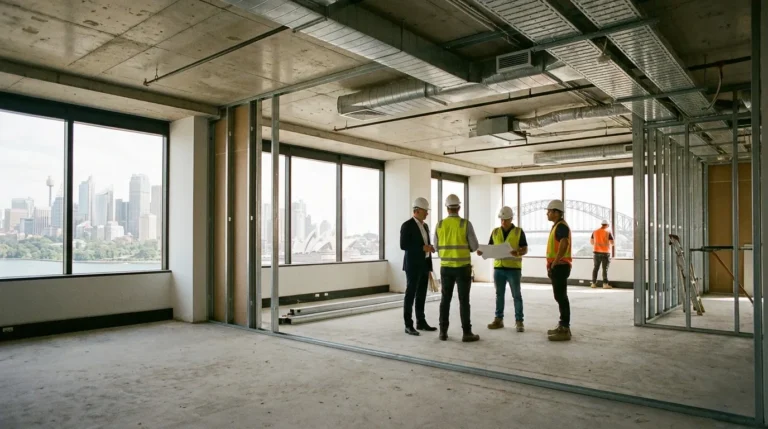
End‑to‑end providers often manage approvals directly and coordinate contractors across stages. Delivery is frequently staged to suit live environments, which matters when buildings remain occupied or works must fit lease expiries. When refurbishments intersect with lease‑end requirements, matching scope to make good obligations usually helps avoid duplicated costs. This is explored further in the office make good guide for lease-end compliance, which asset managers often use as a planning reference.
The most effective commercial renovation projects usually start with a clear brief tied to leasing strategy, not aesthetics alone, particularly when long‑term value is the priority.
Managing Risk and Cost for Commercial Renovation Timelines
Office refurbishment services bring real risk when they’re poorly structured, and the fallout usually appears quickly. Budget blowouts and programme delays are familiar issues for property managers, especially when consultants work in silos and decisions are spread across too many people (you’ve likely seen this yourself). It’s a common pattern and, in my view, one that can often be avoided.
In Sydney, where construction pricing and labour availability can change fast and with little warning, early cost planning sits at the centre of risk control. A capable design and construction partner will usually provide concept‑level cost estimates before the design is locked in. This lets teams test scope against real budget limits rather than hopeful assumptions. There’s little room for guesswork, and planning without clear numbers often increases risk.
Approvals and compliance add another layer of exposure. Council requirements, fire engineering, accessibility standards, and building owner approvals can directly affect delivery timelines. Teams with hands‑on experience across Sydney councils tend to anticipate pressure points and cut down late redesigns that stall progress, often the most frustrating and expensive delays.
Larger occupiers increasingly seek high quality, contiguous floors that support collaboration and workplace experience, and return to office policies have not been uniform across sectors or precincts.
Compressed timeframes are now common, driven by leasing pressure. Staging and programme management matter most when construction sequencing fits tenant marketing schedules, which often improves leasing velocity and limits downtime. Simple alignment, real impact.
Sustainability, Hybrid Work, and Smart Office Design Considerations
Sustainability has moved beyond a “nice to have” and is now basic leasing expectation. ESG performance feeds directly into location decisions, and that shift appears in almost every tenant brief. Refurbished assets are expected to show real gains in energy efficiency and indoor environmental quality, not rely on design stories alone. In my view, those expectations usually tighten over time rather than ease.
The upgrades that matter most are often practical: LED lighting, HVAC optimisation, low‑VOC finishes, and water‑efficient fixtures. They are rarely eye‑catching, but they work. Stronger NABERS and Green Star results follow, and those ratings often lead to rent premiums and, more importantly, higher tenant retention across a lease term, where value builds.
Hybrid work has already reset office design priorities. Desk density is no longer the main measure and hasn’t been for a while. Refurbished workplaces now focus on collaboration areas and flexible, tech‑enabled meeting rooms. Colliers reports that premium refurbishments that fit hybrid work patterns consistently outperform mid‑grade stock in leasing activity, a trend seen across the market.
Smart office technology adds another layer. Occupancy tracking, integrated lighting, and booking systems help tenants adjust space use while giving managers clearer insight into building performance. That level of visibility often matters in competitive Sydney assets, whether they are being leased or actively managed. You can explore these trends in detail in the 2026 Office Technology Forecast: Smart Workplace Trends.
Accessibility, Compliance, and Future-Proofing Your Asset
Long-term risk often shows up first through compliance choices made during refurbishment. Accessibility requirements under the Disability Discrimination Act sit alongside fire regulations and building codes that keep changing and rarely ease. Treating these separately usually pushes costs higher later. In most cases, tackling them together during refurbishment avoids the familiar, and expensive, cycle of retrofits.
Improving amenities and circulation often goes beyond ticking boxes. Upgrading end-of-trip facilities where they already exist can improve inclusivity while reducing future compliance risk. In older buildings, refurbishment is often the only realistic chance to fix legacy constraints that hold back tenant demand and leasing results. This is where value is quietly gained or lost, with few practical alternatives.
Future-proofing, in practice, means making room for change without overbuilding. Flexible layouts and adaptable services tend to extend the value of refurbishment, especially when paired with durable materials. Cameron Williams from Colliers points out that selective premium upgrades now support flight-to-quality demand in Sydney, so restraint still matters.
For managers overseeing multiple assets, shared principles can simplify delivery. But those principles have to flex around each building’s limits. Every asset is different, and that can’t be ignored.
Frequently Asked Questions
How long does a typical office refurbishment project take in Sydney?
Office refurbishment timelines in Sydney usually fall between 8 and 20 weeks. Delays are most often caused by scope and approvals, especially when the building stays occupied. Projects with active workplaces typically move slower because access windows and required sign-offs control progress.
Is refurbishment more cost-effective than a full office rebuild?
Speed often decides it: without structural builds, refurbishment moves quicker and reduces vacancy downtime. Most of the time, it costs less, letting managers improve how the space works and looks without structural work.
Approvals cover council development consent, construction certificates, fire engineering sign-off, and building owner approvals (no exceptions). Shortcuts rarely apply. Requirements vary by location and scope, which is why I rely on consultant engagement.
How does refurbishment improve leasing outcomes?
High-quality refurbishments, matched to tenant expectations, often speed up leasing and support rent premiums. In Sydney’s flight-to-quality market, refurbished assets compete more effectively.
Results improve when refurbishment and make good are planned together. When obligations match refurbishment scopes, teams avoid duplicate work and extra costs. Many property managers plan both, and you should too, using resources like this office make good compliance guide.
Turning Refurbishment Strategy Into Leasing Performance
For Sydney commercial property managers, office refurbishment services work as a strategic lever rather than a routine maintenance task. It’s not just about fixing wear and tear. When refurbishment is tied directly to leasing targets and longer‑term workplace expectations, it can reposition assets quickly, sometimes within a single leasing cycle, while staying cost‑effective.
What often makes the difference is integration. Design decisions, construction planning, compliance requirements (often underestimated), and tenant expectations are best managed as one connected process instead of separate silos. One coordinated effort. Working with an experienced, end‑to‑end commercial renovation partner usually reduces risk and improves delivery certainty, which becomes clear during approvals and at handover.
Vacancy pressure hasn’t eased, and tenants are more selective than before. Leasing performance now often reflects smart refurbishment investment. For assets competing in Sydney’s changing office market, refurbishment sits within the wider property strategy, not alongside it.