
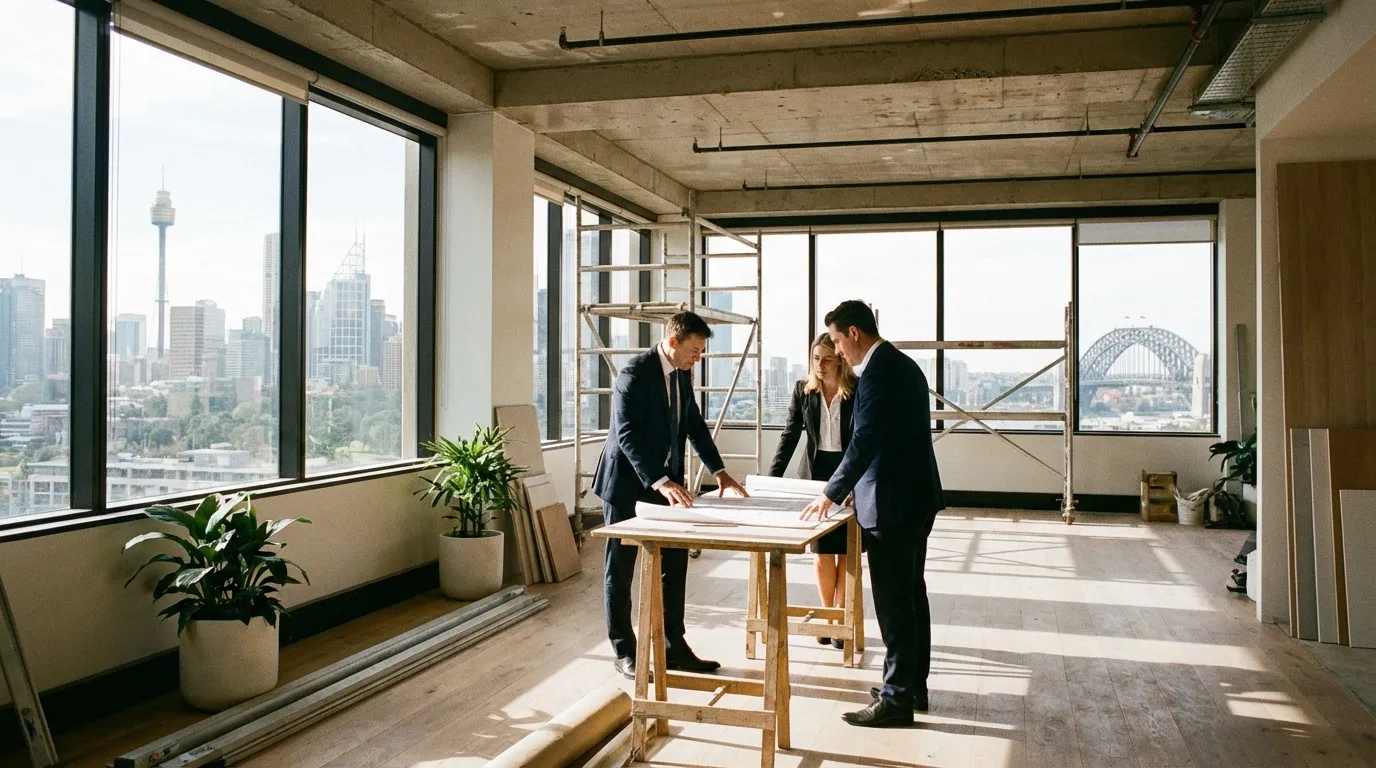
Plan Office Renovation: Step-by-Step Guide for Sydney Businesses
Last updated:
TLDR; The article outlines a structured, five‑step approach to planning a successful office renovation in Sydney, emphasising that early decisions strongly affect productivity, staff satisfaction, costs, and long‑term performance. It stresses defining a clear business case and scope, setting realistic budgets and timelines, and designing for future workplace needs rather than short‑term fixes. Navigating approvals, compliance, and risk early helps avoid delays and costly surprises, while strong project management is critical to keeping the build on track. The key takeaway is that thorough upfront planning reduces downtime, controls costs amid rising construction prices, and results in a workspace that supports both current operations and future growth.
Planning an office renovation in Sydney isn’t something most business owners do often, but the decisions made here usually shape productivity, staff satisfaction, operational efficiency, and long‑term costs for years. The impacts are significant, and they often build over time. With construction costs rising and workplace expectations shifting, a structured approach is no longer optional. What tends to catch people out is how quickly small planning gaps can turn into extended downtime. Whether refreshing an ageing tenancy or rethinking how the team actually uses the space day to day (which often brings surprises), knowing how to plan office renovation projects properly helps protect budgets and limit disruption that drags on longer than expected. In my view, there’s no room for guesswork here, especially when the cost of downtime sits squarely with the business.
This guide is written for Sydney businesses and commercial property managers navigating the commercial renovation process. It covers planning, budgeting, design decisions, approvals, and delivery, with close attention to local market conditions and compliance requirements that do vary here. You’ll find a practical office renovation checklist, clear cost benchmarks from real projects, and insights from industry professionals, grounded in Sydney workplace examples that support hybrid work, match lease obligations, and address sustainability where it makes financial and operational sense.
Step 1: Define the Business Case and Scope Early to Plan Office Renovation
Every successful office renovation starts with clarity, and that requirement is non‑negotiable. Before finishes, layouts, or design details are discussed, the reason for the renovation and how success will be measured for the organisation must be agreed upfront (and not just “it looks better”). The fundamentals are usually consistent: allowing for growth, supporting hybrid work, improving staff wellbeing, or meeting lease compliance. When the business case is unclear, scope creep tends to appear early, and it often becomes one of the biggest risks in a commercial renovation. Decisions lose direction, costs rise, and control can slip, often faster than expected.
In Sydney, those risks are amplified. Cushman & Wakefield reports the city remains one of Australia’s most expensive office fit‑out markets, with average costs around $2,665 per square metre. At that price point, even minor changes to layouts or specifications can quickly turn into major budget overruns. There is usually no room for drift, and the financial impact is felt almost immediately.
| City | Average Fit-Out Cost (AUD/sqm) | Market Context |
|---|---|---|
| Sydney | $2,665 | Highest demand and premium construction costs |
| Melbourne | $2,607 | Slightly lower labour and material costs |
| APAC Average | $2,453 | Moderate fit-out benchmark |
This phase is also where internal alignment needs to happen. Department heads should be involved alongside HR, IT, and finance, especially when technology upgrades or flexible work policies are part of the plan, which they often are. Alignment does not happen automatically. For tenants nearing lease end, understanding make good obligations early is critical. Reviewing an office make good guide at this stage can help avoid unnecessary costs and delays later on.
Step 2: Set a Realistic Budget and Timeline to Plan Office Renovation
The first real pressure point often appears before a single wall is touched. Once the scope is locked in, budgeting becomes the backbone of the office renovation checklist. There are rarely shortcuts at this stage. A realistic budget must cover construction, professional fees, approvals, contingencies, and downtime, not just the visible work on site, which is where many teams misjudge costs. In Sydney, labour availability and site access limits tied to compliance rules affect both cost and timing, often in ways that aren’t obvious at the start. Once work begins, those impacts tend to stack up and are hard to reverse.
According to the JLL Research Team, strong population growth and migration continue to push demand for high‑quality office space across Australasia, and that pressure builds quickly. In my view, this is why early, detailed cost planning usually pays off. It can secure trades and materials before capacity tightens. Leave it too late, and projects are often exposed to price swings and schedule delays that are difficult to pull back. For example, incorporating insights from 2026 Office Technology Forecast: Smart Workplace Trends can help align budget planning with future technology needs.
Strong population growth and positive migration trends are reshaping cities and driving demand for high-quality office spaces across Australasia.
In practice, a typical Sydney office renovation runs from 12 to 26 weeks, depending on complexity. Simpler scopes move faster, while others need extra time for design development, council or landlord approvals, and procurement. A 10, 15% contingency is commonly set aside for issues like services upgrades or base‑building limits that only surface once work starts. This is also when staging is planned, with experienced project managers testing options to control costs while keeping the business running.
Step 3: Develop a Future-Focused Design Strategy
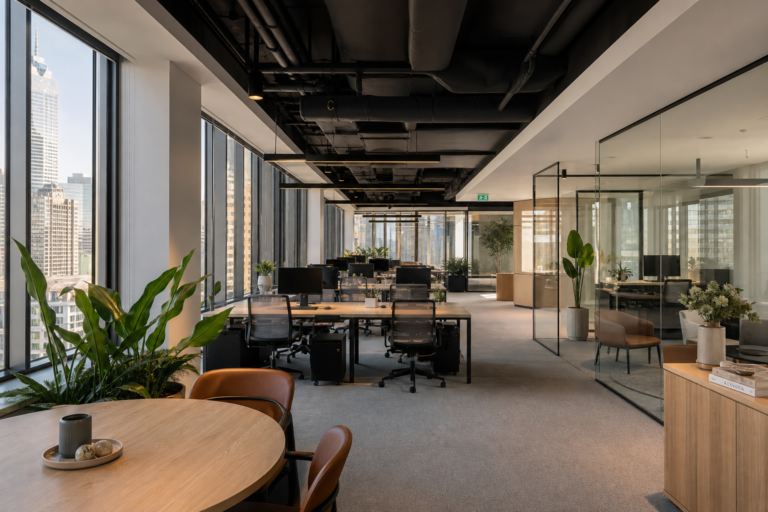
This is the stage where office renovations either deliver real value or miss the mark. Design choices matter because looks alone don’t support a workplace, layouts need to work for how teams operate today and how those habits are likely to change over the next three to five years. Across Sydney, hybrid‑ready planning is now the baseline. Long rows of fixed desks are being replaced with shared, tech‑enabled collaboration zones, a shift already seen in most CBD offices. When planning falls short, the problems usually show up fast in day‑to‑day use, leaving little room for trial and error.
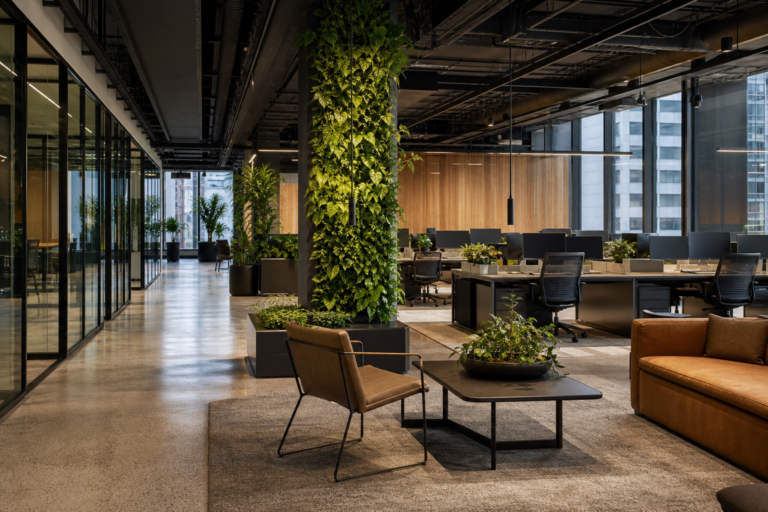
Strong results often come from treating sustainability and wellness as standard expectations, not extras. Low‑impact materials and efficient lighting are now common requirements, while biophilic elements tend to improve comfort and focus more than many teams expect. Reusing existing structures, where it makes sense, can lower costs and still support established ESG objectives without hurting performance or usability.
Technology integration belongs here, not at the end of the process. Smart lighting, access control, and AV‑ready rooms depend on early coordination between designers, builders, and IT consultants who understand how the office actually runs, an approach that often avoids costly rework. Industry reports from CBRE and Raw Commercial, both closely followed for leasing data and workplace performance, consistently show that offices built around flexibility and daily experience see stronger retention. Designing only for current headcount is a common mistake; adaptable spaces that can be reconfigured with minimal disruption usually deliver far greater long‑term value, such as meeting rooms that can be easily rebooked or resized as teams change.
Step 4: Navigate Approvals, Compliance, and Risk
The hardest part is often not the design, it’s the approvals and risk layers around it. Sydney office renovations sit across building codes, Australian Standards, council rules, and landlord conditions, creating pressure points. Accessibility compliance and fire upgrades are common risks. Services coordination often breaks down when left too late. Bringing specialists in early reduces redesigns and schedule overruns.
Cushman & Wakefield Research notes that dedicated cost guides help occupiers plan budgets and meet compliance obligations for office fit outs, especially where approvals and technical standards overlap. This guidance helps most during early planning.
The 2025 Office Fit Out Cost Guide for Australia highlights the latest cost trends, insights, and benchmarks to support corporate occupiers in planning budgets for office fit outs.
Risk management includes contractor selection and project documentation; shortcuts are rare. Clear drawings and specifications remove grey areas. When works match a lease end, coordinating make good obligations cuts duplicated effort.
Step 5: Deliver the Build with Strong Project Management
Pressure shows up fastest during the build, especially in occupied buildings, where access, noise, and staging clash with daily operations. That’s often when problems appear. In these conditions, strong project management keeps trades coordinated in real time, manages variations as they arise, and holds safety and quality standards steady across the works. There’s little margin for error, and you feel it quickly on site.
Clear communication with staff and building management is key here. One useful approach is keeping a single point of accountability across design and construction; this often cuts delays and lowers the risk of cost disputes that drain time and focus. Sydney businesses often underestimate the value of true end-to-end delivery. According to Ben Burston, Chief Economist at Knight Frank Australia, limited future office supply is expected to push rents higher. That outlook usually makes improving existing space more appealing than relocation, a practical reality that’s hard to ignore.
High-quality prime assets are achieving strong leasing outcomes, and we expect rental growth to accelerate in 2026, 27 as the supply pipeline diminishes.
A structured handover process, including defect resolution and documentation, helps the workspace work as intended from day one, for example, when teams return without scrambling around unresolved access or noise issues.
Commonly Asked Questions Answered Here
How long does an office renovation take in Sydney?
Timelines can change based on project size and complexity, which is expected. Most office renovations run 12, 26 weeks, with design and approvals usually included before construction starts.
What should be included in an office renovation checklist?
A checklist defines objectives, budget, timeline, approvals, design, technology, sustainability, compliance, and handover, the main pressure points, cuts risk through the renovation process and leads to fewer surprises, especially at handover.
How much does it cost to renovate an office in Sydney?
Office renovation costs in Sydney commonly land around $2,665 per square metre, but they change with scope and fit‑out quality; this isn’t a fixed price, since basic and premium fit‑outs vary.
Can we renovate without moving out?
Yes, staged renovations often work; success usually relies on planning (likely), safety controls, and clear communication with staff.
Council or certifier approval can apply wider than expected, especially when building services or life‑safety rules change. Getting early advice usually avoids delays by clarifying approval triggers before work starts.
Turning Planning into a Successful Workspace
When steps are skipped, office renovation plans usually unravel, which is why there really aren’t shortcuts (there really aren’t shortcuts). Planning an office renovation means matching the space to the business strategy, and that isn’t optional. Clear priorities matter, often more than people expect (especially early on). With a clear, step‑by‑step approach, Sydney business owners can control costs, limit disruption to day‑to‑day work, and create workplaces that support staff and performance over time. I’ve found the process works best when it starts with the business case, moves through delivery, and builds momentum as each decision shapes the next.
If you’re preparing to plan office renovation works, or want expert guidance through the commercial renovation process, partnering with a Sydney‑based specialist can change the outcome, but only if they understand local regulations and market conditions (that local knowledge often gets overlooked). In my view, this is what reduces risk and keeps projects moving through approvals and delivery.
Make Office Fitouts Sydney a preferred source in Google
One click tells Google to surface our articles more often in Top Stories, AI Overviews and AI Mode.

3 Comments
Comments are closed.