Commercial Office Fitout Sydney: What to Expect
Last updated:
A commercial office fitout Sydney project typically takes between 12 and 24 weeks from initial brief to move-in day, covering strategic planning, design development, council approvals, construction, and final handover. The process transforms a bare or outdated commercial space into a fully functional workplace tailored to how your team actually works. Whether you are leasing new premises in the CBD or upgrading an existing tenancy in Parramatta, North Sydney, or Macquarie Park, understanding what each stage involves helps you set realistic budgets, avoid delays, and get a workspace that performs from day one.
At Office Fitouts Sydney, we guide businesses through every phase of the commercial office fitout process — from the first site walk to handing over the keys. This guide breaks down exactly what to expect so you can plan with confidence.
Why a Commercial Office Fitout Sydney Project Needs a Clear Process
Commercial fitouts are complex undertakings that involve multiple trades, regulatory requirements, and stakeholder interests. Without a structured process, projects drift over budget, blow past deadlines, and deliver spaces that look impressive but do not support productivity.
Sydney’s commercial property market adds its own layer of complexity. Landlord requirements vary building to building. Council approval pathways differ between the City of Sydney, North Sydney Council, and Parramatta City Council. Construction access in CBD towers is restricted to specific hours. A proven process accounts for all of these variables before they become problems.
The seven stages outlined below represent the standard commercial office fitout Sydney workflow used by experienced fitout contractors. Each stage has defined deliverables, decision points, and milestones that keep your project on track.
Stage 1 — Needs Analysis and Project Brief
Every successful fitout begins with understanding how your business operates today and where it needs to be in three to five years. During the needs analysis, your fitout partner will assess:
- Headcount planning — current team size, projected growth, and peak occupancy requirements
- Work modes — the ratio of focused individual work to collaborative team activities
- Technology requirements — AV systems, power and data infrastructure, wireless coverage
- Brand expression — how your physical environment reflects company culture and values
- Compliance needs — industry-specific requirements such as acoustic privacy for financial services or infection control for healthcare
- Budget parameters — establishing a realistic cost envelope before design begins
The output is a detailed project brief that becomes the single reference document for every decision made during the commercial office fitout Sydney process. A thorough brief at this stage prevents expensive changes during construction.
Stage 2 — Concept Design and Space Planning
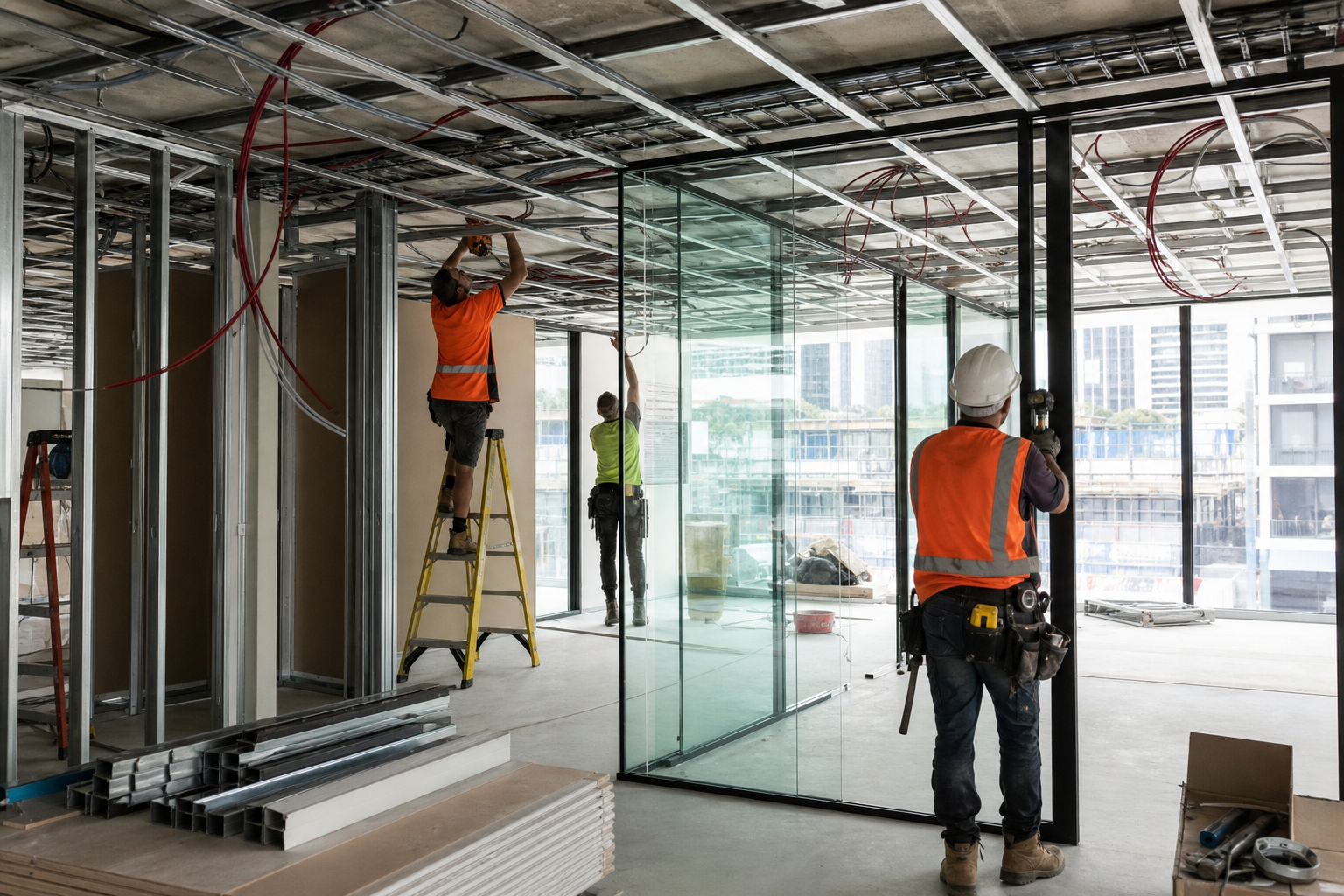
With the brief locked in, the design team translates operational requirements into a physical layout. This stage typically produces:
- Floor plan options — usually two or three layout concepts showing different approaches to the same space
- Space allocation — sizing for open workstations, private offices, meeting rooms, breakout areas, kitchens, and amenities
- Circulation planning — ensuring compliant egress paths and intuitive wayfinding throughout the tenancy
- Adjacency mapping — placing teams and functions in logical proximity based on workflow dependencies
For a typical 500 square metre Sydney tenancy, you should expect two to three rounds of concept refinement before the preferred layout is confirmed. Rushing this stage of your commercial office fitout Sydney project leads to compromised layouts that no amount of premium finishes can fix.
Activity-Based Working Layouts
In 2026, most commercial office fitout Sydney projects incorporate some form of activity-based working (ABW). Rather than assigning fixed desks, ABW provides a variety of settings — quiet focus zones, collaborative neighbourhoods, informal meeting areas, and phone booths — that employees choose based on their current task.
Research from Leesman, the workplace effectiveness benchmarking firm, shows that offices with well-implemented ABW score 15 to 20 percent higher on employee satisfaction compared to traditional fixed-desk environments. However, ABW must be calibrated to your specific work patterns. A law firm’s ratio of focus-to-collaboration space will differ dramatically from a creative agency’s.
Stage 3 — Detailed Design and Documentation
Once the concept layout is approved, the design moves into full documentation. This is the technical stage where architectural drawings, services engineering, and specifications come together into a construction-ready package.
Key deliverables include:
- Architectural drawings — detailed plans, sections, and elevations showing every wall, door, glazing panel, and joinery element
- Mechanical services design — HVAC modifications to suit the new layout, including supplementary cooling for server rooms or high-density zones
- Electrical and data design — power outlet locations, lighting layouts, data cabling pathways, and switchboard modifications
- Fire engineering — sprinkler head relocation, emergency lighting, exit signage, and smoke detection updates to comply with the National Construction Code (NCC 2025)
- Hydraulic design — kitchen and bathroom plumbing modifications
- Joinery and furniture specifications — custom joinery shop drawings and commercial furniture selections
The documentation package is what your fitout contractor prices against, what council assesses for compliance, and what the building certifier references during inspections. Incomplete documentation is the single biggest cause of cost blowouts in any commercial office fitout Sydney project, and it is entirely avoidable with proper design management.
Stage 4 — Approvals and Permits for Your Commercial Office Fitout Sydney Project
Sydney commercial fitouts require several layers of approval before construction can begin. Missing any one of these can halt your project and cost weeks of delay.
Landlord Approval
Your lease will specify a fitout approval process. Most commercial landlords in Sydney require submission of full architectural and services drawings for review by their building manager and sometimes their own engineer. Landlord approval typically takes two to four weeks and may include conditions around working hours, materials, contractor insurance, and make-good obligations.
Council and Building Approvals
Depending on the scope of work, your commercial office fitout Sydney project may require a Development Application (DA) or a Complying Development Certificate (CDC). The determining factors are:
- Change of use — converting a retail space to office, or modifying classification within the BCA
- Heritage-listed buildings — any work in a heritage building or conservation area triggers additional approvals
- Structural modifications — removing or adding walls that form part of the building structure
- Fire safety upgrades — major changes to fire compartmentation, exits, or building services
For straightforward internal fitouts that do not change the building classification, a Construction Certificate (CC) or CDC issued by a private certifier is usually sufficient. Processing typically takes one to three weeks.
NCC 2025 Compliance
The National Construction Code 2025 introduced updated energy efficiency provisions that directly impact commercial fitouts. Key requirements include reduced maximum illumination power density (now 5–7 W/m² for office lighting), mandatory lighting controls in more building types, and expanded daylight harvesting provisions for perimeter zones. Your fitout documentation must demonstrate compliance with these standards.
Stage 5 — Construction and Fitout Delivery
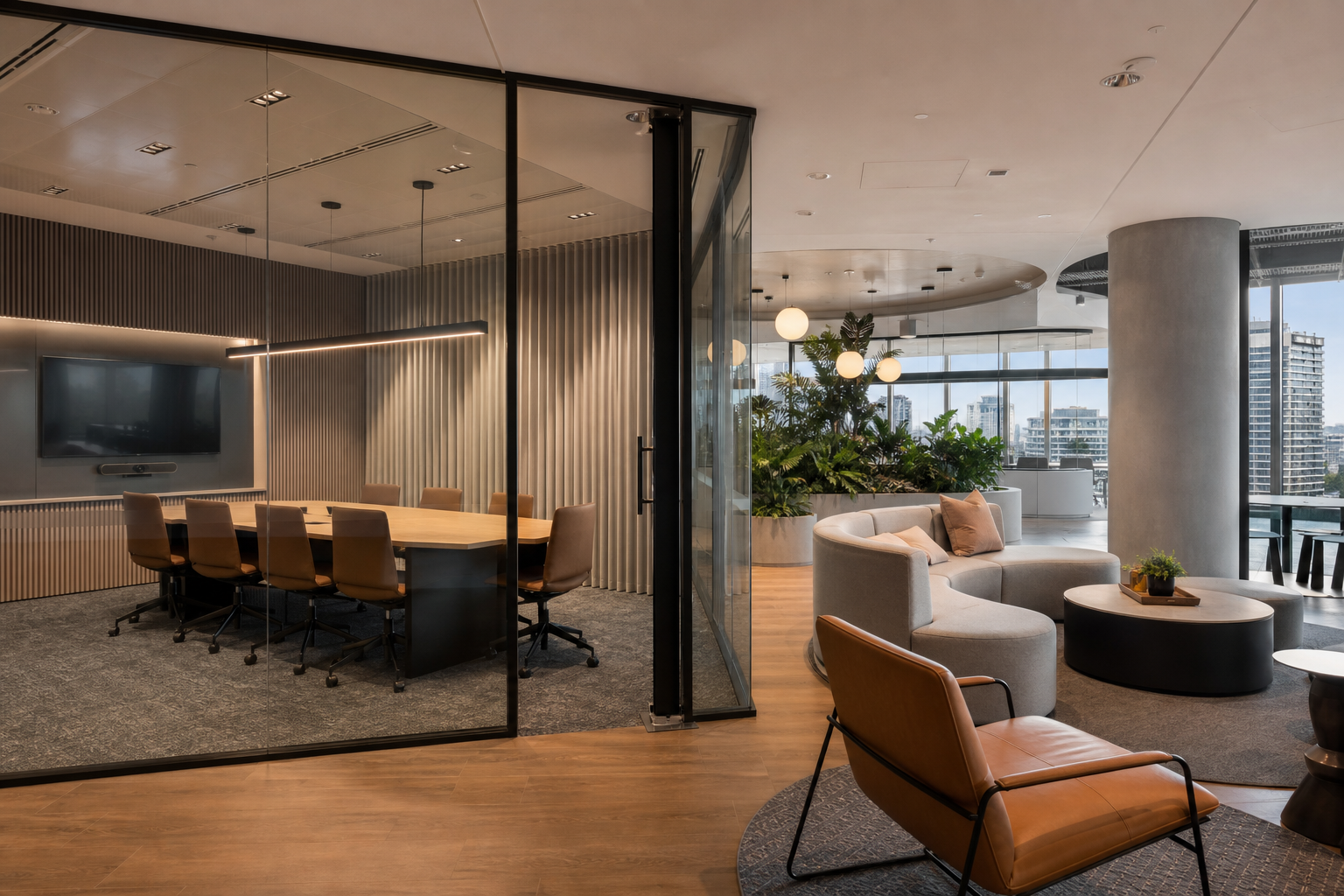
With approvals secured, construction begins. A well-managed commercial fitout Sydney project follows a logical construction sequence that minimises rework and keeps trades productive.
Typical Construction Sequence
- Strip-out and demolition — removing existing partitions, ceiling tiles, floor coverings, and redundant services (1–2 weeks)
- First fix services — routing mechanical ductwork, electrical cabling, data infrastructure, and plumbing rough-ins above ceiling and within walls (2–3 weeks)
- Partition framing and plasterboard — erecting steel-stud wall frames, installing plasterboard, and setting door frames (2–3 weeks)
- Ceiling installation — suspended ceiling grid, tiles, and bulkhead construction (1–2 weeks)
- Second fix services — mounting light fittings, power outlets, data points, air diffusers, and plumbing fixtures (1–2 weeks)
- Joinery installation — reception counters, kitchen cabinetry, storage units, and built-in workstations (1–2 weeks)
- Floor coverings — carpet tiles, vinyl planking, polished concrete, or timber flooring (1 week)
- Painting and finishing — wall painting, feature walls, signage, and final detailing (1 week)
- Furniture delivery and installation — workstations, task chairs, meeting tables, and soft furnishings (2–5 days)
- IT and AV commissioning — network testing, AV calibration, access control setup, and phone system activation (2–5 days)
For a 500 square metre tenancy, expect the construction phase to take 8 to 14 weeks depending on complexity and the number of bespoke elements. CBD commercial office fitout Sydney projects often take longer due to restricted delivery windows and lift access scheduling.
Managing Disruption During Construction
If your team is occupying the space during the fitout — common in staged refurbishment projects — your contractor should provide a detailed staging plan that sequences work to minimise noise and dust in occupied zones. Temporary hoarding, after-hours noisy works, and phased relocations are standard strategies used by experienced office fitout specialists in Sydney.
How Much Does a Commercial Office Fitout Sydney Project Cost?
Fitout costs vary significantly based on the level of finish, building constraints, and project complexity. In 2026, Sydney commercial office fitout costs typically fall into three tiers:
| Fitout Level | Cost per sqm (2026) | What’s Included |
|---|---|---|
| Basic / Shell | $800 – $1,200 | Paint, carpet tiles, basic lighting, minimal partitions, reused furniture |
| Mid-Range | $1,200 – $2,000 | Custom joinery, glass partitions, upgraded finishes, new furniture, AV in meeting rooms |
| Premium / High-End | $2,000 – $3,500+ | Bespoke design, premium materials, full AV integration, custom furniture, feature elements |
These figures include design fees, construction, furniture, and technology but exclude GST. For a 400 square metre mid-range commercial office fitout Sydney businesses would be budgeting approximately $480,000 to $800,000 as a guide. For a detailed cost breakdown, see our office fitout cost guide.
Hidden Costs to Budget For
Beyond the headline cost per square metre, budget for these commonly overlooked items:
- Base building works — modifications to the landlord’s building systems (fire, mechanical, electrical) that fall outside your tenancy fitout scope but are triggered by your design
- Make-good provision — setting aside funds for lease-end reinstatement, typically $150–$300 per square metre
- IT relocation — moving servers, configuring networks, and setting up new meeting room technology
- Moving costs — professional relocation services, temporary storage, and downtime allowances
- Contingency — a minimum 10 percent contingency on total project cost to cover unforeseen issues
- Professional fees — design, project management, building certification, and quantity surveying fees typically add 10–15 percent
Commercial Office Fitout Sydney Timeline: Week by Week
Understanding the full timeline helps you plan lease commencement dates, furniture procurement, and staff communication. Here is a realistic week-by-week breakdown for a mid-range 400–600 square metre fitout:
| Phase | Duration | Weeks (Cumulative) |
|---|---|---|
| Needs analysis and brief | 1–2 weeks | 1–2 |
| Concept design | 2–3 weeks | 3–5 |
| Detailed design and documentation | 3–4 weeks | 6–9 |
| Approvals (landlord, council, certifier) | 2–4 weeks | 8–13 |
| Construction | 8–14 weeks | 16–27 |
| Defects and snagging | 1 week | 17–28 |
| Furniture and IT commissioning | 1–2 weeks | 18–30 |
The most common cause of timeline blowouts in a commercial office fitout Sydney engagement is slow decision-making during the design phase. Every week of indecision on layout or finishes pushes your move-in date by a week. Assign a dedicated internal project sponsor with authority to make timely decisions.
Choosing the Right Commercial Office Fitout Partner
The fitout company you choose has more impact on the outcome than any individual design decision. When evaluating commercial office fitout Sydney contractors, assess these five criteria:
- Design-and-construct capability — a single firm managing both design and construction eliminates the coordination risk between separate designers and builders
- Relevant project experience — ask for case studies in your building type, industry, and project size. A contractor experienced in heritage CBD buildings faces different challenges than one specialising in new A-grade towers
- Financial stability — check that the contractor carries adequate professional indemnity, public liability, and workers compensation insurance. Request recent financial statements for projects over $500,000
- Trade relationships — established subcontractor relationships mean reliable availability, competitive pricing, and consistent quality across mechanical, electrical, joinery, and finishing trades
- Communication and reporting — expect weekly progress reports with photos, updated programme schedules, and cost tracking. A good contractor communicates proactively, not just when problems arise
At Office Fitouts Sydney, we provide a fully integrated design-and-construct service, giving you a single point of accountability from concept through to handover.
Key Trends Shaping Commercial Office Fitouts in Sydney for 2026
The commercial fitout landscape continues to evolve. Here are the trends most influencing Sydney fitout projects right now:
Resimercial Design
Blending residential warmth with commercial functionality, resimercial design uses soft furnishings, warm timber tones, and living room-style breakout areas to create workplaces that feel welcoming rather than institutional. This trend is driving demand for higher-quality finishes in communal areas.
Sustainability and NCC 2025 Compliance
With the NCC 2025 energy provisions now in effect and AASB S2 sustainability reporting mandatory from January 2026 for Group 2 entities, commercial fitouts increasingly need to demonstrate environmental credentials. Low-VOC materials, energy-efficient LED lighting, recycled content in flooring and partitions, and NABERS-rated mechanical systems are becoming standard rather than premium inclusions.
Neurodiversity-Inclusive Design
Forward-thinking fitouts now incorporate design elements that support neurodiverse team members. Quiet rooms with acoustic isolation, adjustable lighting zones, low-stimulus focus areas, and clear spatial wayfinding make workplaces more inclusive and productive for everyone.
Hybrid-Ready Infrastructure
With hybrid work patterns now firmly established, every modern commercial office fitout Sydney workspace prioritises bookable desks, video-enabled meeting rooms, acoustic phone booths, and robust wireless infrastructure. The space-per-person ratio has shifted from 10–12 square metres per permanent desk to 14–18 square metres per person in hybrid environments, where fewer desks serve a larger rotating workforce.
Frequently Asked Questions About Commercial Office Fitout Sydney
How long does a commercial office fitout take in Sydney?
A typical commercial office fitout Sydney project takes 12 to 30 weeks from initial brief to move-in, depending on the size and complexity of the space. A straightforward 300 square metre fitout can be completed in 12 to 16 weeks, while a complex 1,000+ square metre project with custom joinery and full services upgrades may take 20 to 30 weeks.
What is the average cost of a commercial office fitout in Sydney?
In 2026, commercial office fitout costs in Sydney range from $800 per square metre for a basic fitout to $3,500+ per square metre for a premium, fully bespoke workspace. A mid-range fitout typically costs between $1,200 and $2,000 per square metre, including design, construction, furniture, and technology.
Do I need council approval for an office fitout in Sydney?
Most internal office fitouts in Sydney do not require a full Development Application. However, you will typically need a Construction Certificate or Complying Development Certificate issued by a private building certifier. Fitouts involving a change of use, structural modifications, or heritage-listed buildings may require council approval.
What is included in a commercial office fitout?
A comprehensive commercial office fitout includes space planning, interior design, demolition of existing elements, construction of new partitions and ceilings, mechanical and electrical services, joinery, floor coverings, painting, furniture supply and installation, IT and AV fit-out, and project management. The scope depends on whether you are fitting out a shell space or refurbishing an existing tenancy.
Should I choose a design-and-construct fitout company?
A design-and-construct model is recommended for most commercial office fitout Sydney projects. It provides a single point of contact and accountability, streamlines communication, reduces coordination risk, and often delivers faster timelines and better cost control compared to engaging separate design and construction firms. Learn more about our commercial fitout approach.
What are the biggest risks in a commercial office fitout?
The most common risks are incomplete documentation leading to cost overruns, slow decision-making causing delays, inadequate contingency budgets, hidden building conditions discovered during demolition, and choosing a contractor based solely on the lowest price without verifying experience and financial stability.
How do I minimise disruption during an office fitout?
For staged fitouts where staff remain in the building, use temporary hoarding to separate construction zones from occupied areas, schedule noisy works outside business hours, implement a phased relocation plan, and maintain clear communication with staff about the project timeline and any temporary inconveniences.
Make Office Fitouts Sydney a preferred source in Google
One click tells Google to surface our articles more often in Top Stories, AI Overviews and AI Mode.