Office Fit Out Sydney: Every Step Explained
Last updated:
An office fit out Sydney project typically takes between 12 and 30 weeks from initial brief to move-in day, depending on the size and complexity of the space. The process follows a clear sequence: brief and needs analysis, concept design, detailed design, landlord and council approvals, procurement, construction, defects inspection, and handover. Understanding every step before you start protects your budget, keeps your timeline on track, and ensures your finished workspace genuinely supports the way your team works. This guide from Office Fitouts Sydney breaks down each phase so you know exactly what to expect.
Why a Structured Office Fit Out Process Matters
Sydney’s commercial property market moves quickly. Lease incentives, builder availability, and material lead times all fluctuate, and a poorly planned fit out can blow past its deadline by months. A structured process gives you control over three things that matter most: cost certainty, schedule predictability, and design quality.
Businesses that skip the planning phase often end up paying for expensive variations during construction. The NSW Fair Trading building guidelines recommend documenting scope and contracts before any physical work begins — advice that applies equally to commercial fit outs.
A well-managed office fit out in Sydney also keeps your team productive during the transition. When every milestone is mapped in advance, you can coordinate IT migration, furniture delivery, and staff relocation without last-minute chaos.
Step 1: Brief and Needs Analysis
Every successful office fit out Sydney project starts with a thorough brief. This is where you define the business objectives the new workspace needs to support. Are you consolidating floors? Transitioning to activity-based working? Accommodating headcount growth? Your brief shapes every decision that follows.
What to Include in Your Fit Out Brief
- Headcount and growth forecast — current team size plus projected growth over the lease term
- Work style analysis — ratio of collaborative to focused work, meeting frequency, client-facing needs
- Budget parameters — target spend range and whether landlord incentives are available
- Timeline constraints — lease start date, notice period on current premises, business-critical deadlines
- Technology requirements — AV systems, cabling density, server room or comms room specifications
- Brand and culture priorities — how the space should feel, reflect company values, and support wellbeing
At this stage, a site survey of the base building is essential. Your fit out team needs to assess existing services — mechanical, electrical, hydraulic, and fire — to understand what can be reused and what needs upgrading.
Step 2: Concept Design for Your Office Fit Out Sydney Project
Concept design translates your brief into spatial ideas. Your designer or design-and-construct partner will present two or three layout options, each showing how departments, circulation zones, meeting rooms, and amenities fit within the floor plate.
Key decisions made during concept design include:
- Open plan vs enclosed offices — the ratio between shared workstations and private spaces
- Collaboration zones — breakout areas, town halls, brainstorming rooms
- Support spaces — kitchens, end-of-trip facilities, wellness rooms, print and copy areas
- Reception and client areas — first-impression zones that reflect your brand
- Acoustic strategy — how sound will be managed across open and enclosed areas
A good concept design balances aspiration with practicality. It should visualise the finished space through 3D renders or mood boards while staying firmly grounded in the realities of the building’s structure, services, and your budget.
Step 3: Detailed Design and Documentation
Once the concept is approved, the design team produces detailed construction documentation. This package includes architectural drawings, reflected ceiling plans, electrical and data layouts, joinery details, finishes schedules, and specifications for every material and fitting.
Design Documentation Checklist
- Floor plans with dimensions and furniture layouts
- Reflected ceiling plans showing lighting, sprinklers, and HVAC diffusers
- Electrical and data outlet plans
- Joinery and millwork drawings with sections and details
- Finishes schedule — flooring, wall treatments, ceiling tiles, paint colours
- Door and hardware schedule
- Signage and wayfinding plan
- Mechanical and fire services coordination drawings (if modifying base building)
Thorough documentation reduces variations during construction. Every detail that is resolved on paper costs a fraction of what it costs to resolve on site. For a typical best office fitout in Sydney, the design phase usually takes four to eight weeks depending on complexity.
Step 4: Approvals — Landlord and Council
Before construction starts on any office fit out in Sydney, you need the right approvals. Most commercial leases require written landlord consent for fitout works, and certain types of work may also need council or certifier approval.
Landlord Approval
Your lease will specify the process for obtaining landlord consent. Typically you submit your design drawings, a scope of works, contractor details, and proof of insurance. Allow two to four weeks for landlord review, and start this process as soon as detailed design is complete.
Key items landlords assess include:
- Impact on base building services and structure
- Compliance with building house rules and aesthetic guidelines
- Contractor credentials and insurance certificates
- Make-good obligations at lease end
Council and Building Approvals
Many internal office fit outs in Sydney are classified as exempt or complying development under the State Environmental Planning Policy (Exempt and Complying Development Codes). However, works that modify fire compartments, change the building classification, or affect the building envelope may require a Development Application (DA) or a Complying Development Certificate (CDC).
Work with a Building Certifier or Principal Certifying Authority (PCA) to determine which approval pathway applies. This is especially important if your fit out includes:
- New kitchen or shower amenities (hydraulic modifications)
- Changes to fire egress paths or fire compartments
- Structural modifications like new openings or mezzanines
- Changes to the building’s BCA classification
The National Construction Code (NCC) 2025, published for preview in February 2026 with adoption from May 2026, introduces updated requirements for energy efficiency and accessibility that may affect new fit out projects.
Step 5: Procurement and Contractor Selection
With approvals in hand, the next step is engaging your construction team. For an office fit out Sydney project, you typically have three procurement routes:
Design and Construct (D&C)
A single firm handles both design and construction. This streamlines communication, reduces the risk of design-versus-builder disputes, and often delivers faster timelines. It is the most popular approach for mid-sized Sydney office fit outs.
Traditional Tender
A separate designer creates the documentation, then multiple builders price the work competitively. This approach suits larger projects where cost transparency and competitive pricing are priorities.
Construction Management
A construction manager oversees the project and engages individual trade contractors directly. This provides maximum flexibility and transparency but requires experienced management to coordinate multiple subcontractors.
Regardless of procurement method, ensure your contracts clearly define scope, pricing structure (fixed price or cost-plus), variation procedures, timeline milestones, liquidated damages, defects liability period, and insurance requirements.
Step 6: Pre-Construction Planning
Before the first tradesperson sets foot on site, several critical activities must happen:
- Building induction — your contractor completes the building’s induction requirements, including occupational health and safety protocols
- Delivery logistics — confirm loading dock bookings, goods lift availability, and permitted work hours
- Services isolation plan — coordinate with building management for any planned shutdowns of mechanical, electrical, or fire systems
- Construction programme — a detailed Gantt chart or programme showing every trade sequence, lead times for long-lead items, and key milestone dates
- Hoarding and protection — install hoarding to separate the construction zone from occupied areas, protecting existing tenants from noise, dust, and disruption
This phase typically takes one to two weeks but saves significant time during construction by preventing delays from missed bookings or unapproved access.
Step 7: Construction and Fit Out
Construction is where your office fit out Sydney project takes physical shape. The typical trade sequence for a commercial fit out runs as follows:
Typical Construction Sequence
- Demolition and strip-out — remove existing partitions, ceilings, flooring, and redundant services
- First fix services — rough-in mechanical (HVAC), electrical, data, hydraulic, and fire services within the ceiling and walls
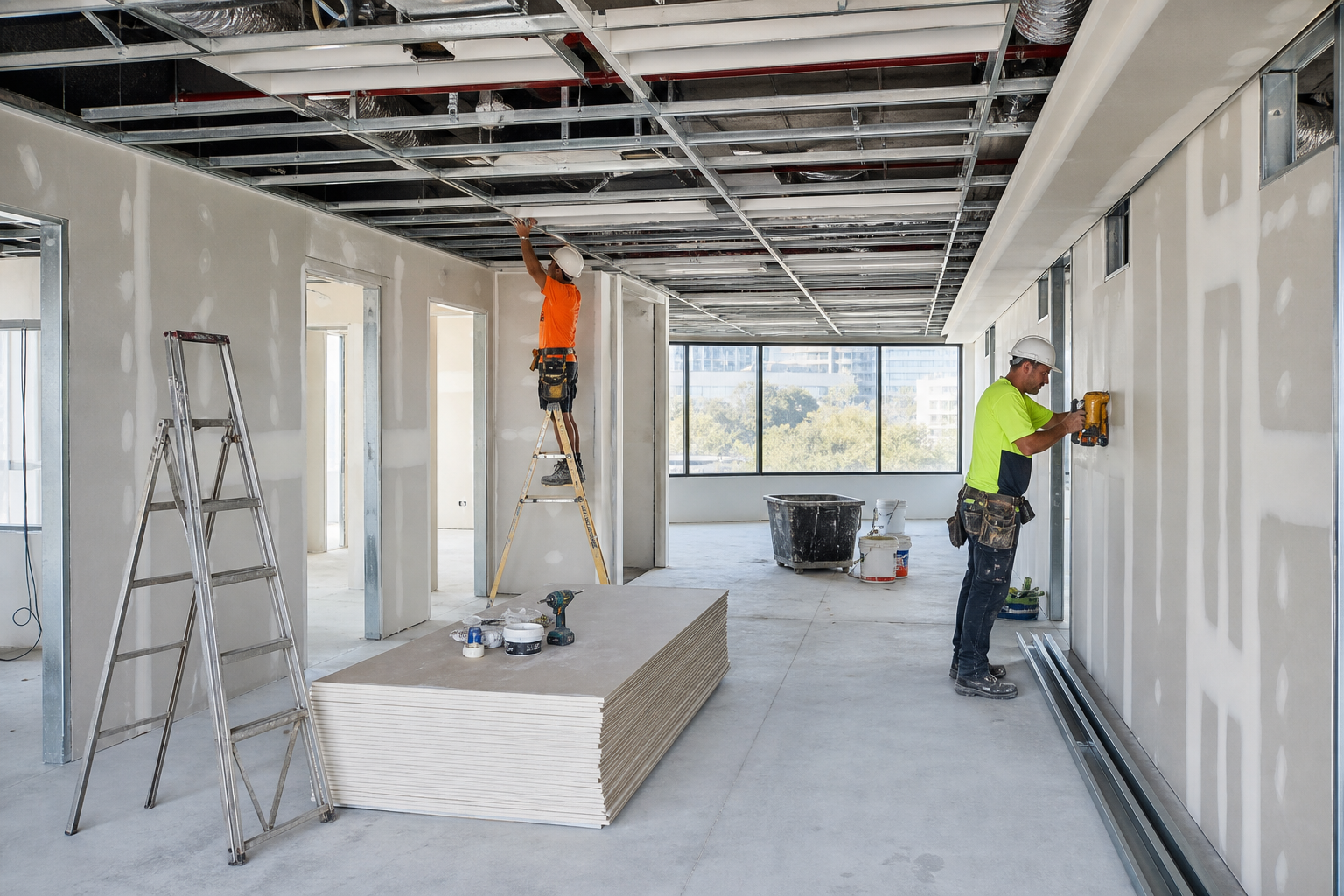
- Partition framing — erect steel stud frames for plasterboard walls, including blocking for heavy fixtures
- Ceiling grid installation — install suspended ceiling grid and integrate lighting, sprinklers, and diffusers
- Plasterboard lining and stopping — line partition frames, tape, and set joints ready for painting
- Joinery installation — fit reception desks, kitchen cabinetry, storage units, and custom millwork
- Glazing and partitions — install glass partitions, doors, and hardware
- Painting — apply primers and finish coats to walls, bulkheads, and ceilings
- Flooring — lay carpet tiles, vinyl plank, polished concrete, or timber flooring
- Second fix services — install power outlets, light fittings, data points, plumbing fixtures, and HVAC grilles
- Furniture and workstation installation — assemble and place desks, chairs, storage, and soft furnishings
- AV and IT commissioning — set up screens, video conferencing, network switches, and Wi-Fi access points
- Clean and snag — deep clean the entire space and compile a defects list
Construction duration varies by project size. A small office of 200 square metres might take four to six weeks on site, while a full-floor fit out of 1,000 square metres or more typically requires eight to fourteen weeks of construction.
Managing Quality During Your Office Fit Out
Quality management during construction is non-negotiable. Your project manager should be conducting regular site inspections, typically two to three times per week, to verify workmanship against the approved drawings and specifications.
Key quality checkpoints include:
- Set-out verification — confirming partition positions match the floor plan before framing begins
- Services rough-in inspection — checking electrical, data, and mechanical rough-ins before ceilings are closed
- Joinery pre-delivery inspection — reviewing custom joinery at the workshop before it arrives on site
- Paint and finish samples — approving colours and textures on site before full application
- Practical completion walkthrough — a formal inspection identifying defects that must be rectified before handover
Documenting quality issues in real time through a digital defects management platform keeps accountability clear and ensures nothing slips through the cracks.
Step 8: Handover and Post-Occupancy
Handover marks the transition from construction to occupation. At practical completion, your contractor provides a package of handover documentation including:
- As-built drawings reflecting any changes made during construction
- Operation and maintenance manuals for all installed equipment
- Warranty certificates for materials and workmanship
- Test and commissioning certificates for mechanical, electrical, and fire systems
- Building compliance certificates as required
A defects liability period — typically 12 months — begins at practical completion. During this time, the contractor is obligated to return and rectify any defects that emerge under normal use.
Post-Occupancy Evaluation
Smart businesses conduct a post-occupancy evaluation (POE) at the 3-month and 12-month marks. A POE surveys staff satisfaction, assesses whether the space supports the intended work patterns, and identifies any adjustments needed. It closes the feedback loop and ensures the investment in your office fit out Sydney project delivers the intended results.
Office Fit Out Costs in Sydney: What to Budget
Budgeting accurately is one of the most important parts of an office fit out. Sydney costs vary significantly based on the level of finishes, the complexity of services, and the condition of the base building. Here are current benchmarks:
- Basic fit out — $600 to $800 per square metre. Functional spaces with standard workstations, basic partitions, and minimal design features.
- Mid-range fit out — $850 to $1,400 per square metre. A mix of open and enclosed spaces, quality finishes, branded reception, and breakout areas.
- Premium fit out — $1,500 to $3,500+ per square metre. High-end finishes, custom joinery, advanced AV and automation, bespoke design throughout.
For a 500 square metre mid-range office fit out Sydney project, you would typically budget between $425,000 and $700,000 including design fees, construction, furniture, and AV. Always include a contingency of 10 to 15 percent for unforeseen site conditions or scope changes.
2026 Trends Shaping the Office Fit Out Sydney Market
Several trends are influencing how businesses approach their fit out projects in 2026:
- Activity-based working (ABW) — designing for a variety of work modes rather than assigned desks, with neighbourhoods, focus pods, collaboration zones, and social hubs
- Resimercial design — incorporating residential-style materials and furnishings into commercial spaces to create warmth, comfort, and a sense of belonging
- Biophilic design — integrating natural elements such as living walls, indoor planting, natural timber, and maximised daylight to improve wellbeing and productivity
- Sustainability compliance — AASB S2 mandatory climate reporting, which took effect 1 January 2026 for Group 2 entities, means fit out decisions now carry Scope 3 emissions implications that appear in financial disclosures
- Acoustic performance — full-occupancy acoustic planning with sound masking, absorptive materials, and room-in-room meeting pods to handle the noise challenges of higher office utilisation
- Integrated technology — purpose-designed AV rooms, wireless presentation systems, occupancy sensors, and smart building controls built into the fitout from day one
These trends reflect a broader shift: the 2026 office is no longer just a place to work. It is a strategic asset designed to attract talent, support diverse work styles, and demonstrate corporate responsibility.
How Office Fitouts Sydney Manages the Process
Office Fitouts Sydney provides end-to-end project management across every phase described in this guide. From the initial brief through concept design, documentation, approvals, construction, and handover, a dedicated project manager coordinates every trade and stakeholder.
This design-and-construct approach means one team is accountable for the entire project — eliminating the gaps and finger-pointing that can occur when design and construction are handled by separate firms. It also means faster delivery, because construction planning starts during the design phase rather than after it is complete.
Whether you are fitting out 100 square metres for a growing startup or 2,000 square metres for a corporate headquarters, the process scales to suit. Every project follows the same disciplined methodology, ensuring nothing is missed and the finished space exceeds expectations.
Frequently Asked Questions About Office Fit Out Sydney
What is the difference between an office fit out and an office renovation?
An office fit out transforms a bare or empty commercial space into a functional workplace, installing everything from partitions and ceilings to services and furniture. An office renovation updates or refreshes an existing occupied space. Fit outs are typically more comprehensive and start from a shell or stripped-back condition.
How long does an office fit out Sydney project take from start to finish?
Most office fit out projects in Sydney take 12 to 30 weeks from brief to move-in. A small space under 300 square metres can be completed in 12 to 16 weeks. Larger or more complex projects with custom joinery, extensive services modifications, or council approvals may take 20 to 30 weeks.
Do I need council approval for an office fit out in Sydney?
Many internal office fit outs are classified as exempt development and do not require council approval. However, if your fit out involves changes to fire compartments, structural modifications, or changes to the building classification, you will need either a Complying Development Certificate or a Development Application. A Building Certifier can advise on the correct pathway.
What does an office fit out cost per square metre in Sydney?
Current Sydney benchmarks range from $600 per square metre for a basic fit out to $3,500 or more per square metre for premium projects. A mid-range office fit out typically costs between $850 and $1,400 per square metre, including design, construction, and furniture.
Should I choose a design-and-construct firm or separate designer and builder?
A design-and-construct approach offers faster timelines, single-point accountability, and often lower overall costs because the builder is involved in design decisions from the start. Separate designer-and-builder arrangements can provide more design independence and competitive pricing through traditional tendering but require more coordination.
What should I look for in an office fit out contractor in Sydney?
Check their portfolio of completed Sydney projects, ask for references from recent clients, verify their insurance and licensing, review their approach to project management and communication, and ensure they have experience with your building type and size. A strong contractor will also guide you through approvals and compliance requirements.
How do I minimise disruption during an office fit out?
Plan the move sequence carefully, stage the fit out if you are remaining in the space, coordinate IT migration well in advance, and choose a contractor experienced in occupied-space works. Clear communication with building management about loading dock access, work hours, and noise restrictions is essential. Your fit out partner in Sydney should manage all of this as part of their service.
Make Office Fitouts Sydney a preferred source in Google
One click tells Google to surface our articles more often in Top Stories, AI Overviews and AI Mode.