Office Refurbishment Sydney: Cost, Timeline & Process
Last updated:
Office refurbishment Sydney projects typically cost $800–$2,500 per square metre and take 8–20 weeks from brief to practical completion, depending on scope, specification level, and whether the existing fitout is retained or stripped back. Unlike a new fitout that starts from a base-building shell, an office refurbishment works with what is already there — improving layout, finishes, lighting, and services to bring an ageing workspace up to modern standards. At Office Fitouts Sydney, we handle every stage of office refurbishment projects across the CBD, North Sydney, Parramatta, and surrounding areas.
What Is Office Refurbishment Sydney — and How Does It Differ From a Fitout?
The terms “office refurbishment” and “office fitout” are often used interchangeably, but they describe different scopes of work. Understanding the distinction helps you plan budget, timeline, and approvals accurately.
An office fitout typically starts from a bare or base-building shell — a newly leased floor with no walls, no joinery, and minimal services. Everything is built from scratch: partitioning, ceilings, lighting, flooring, joinery, and mechanical connections.
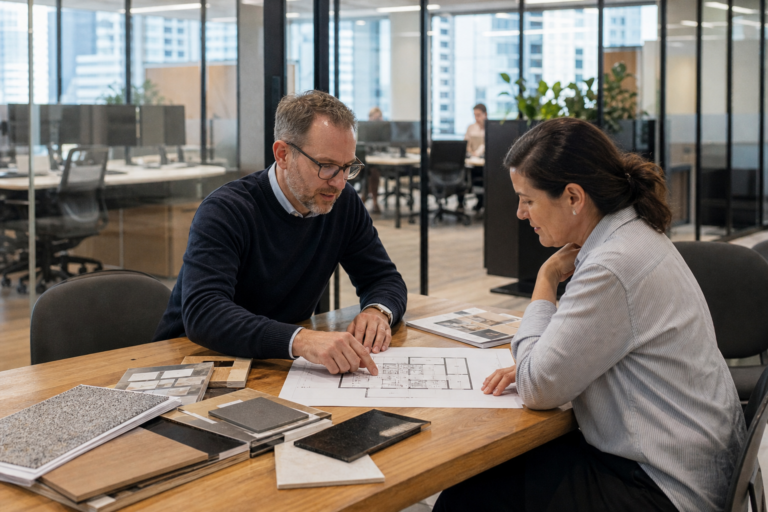
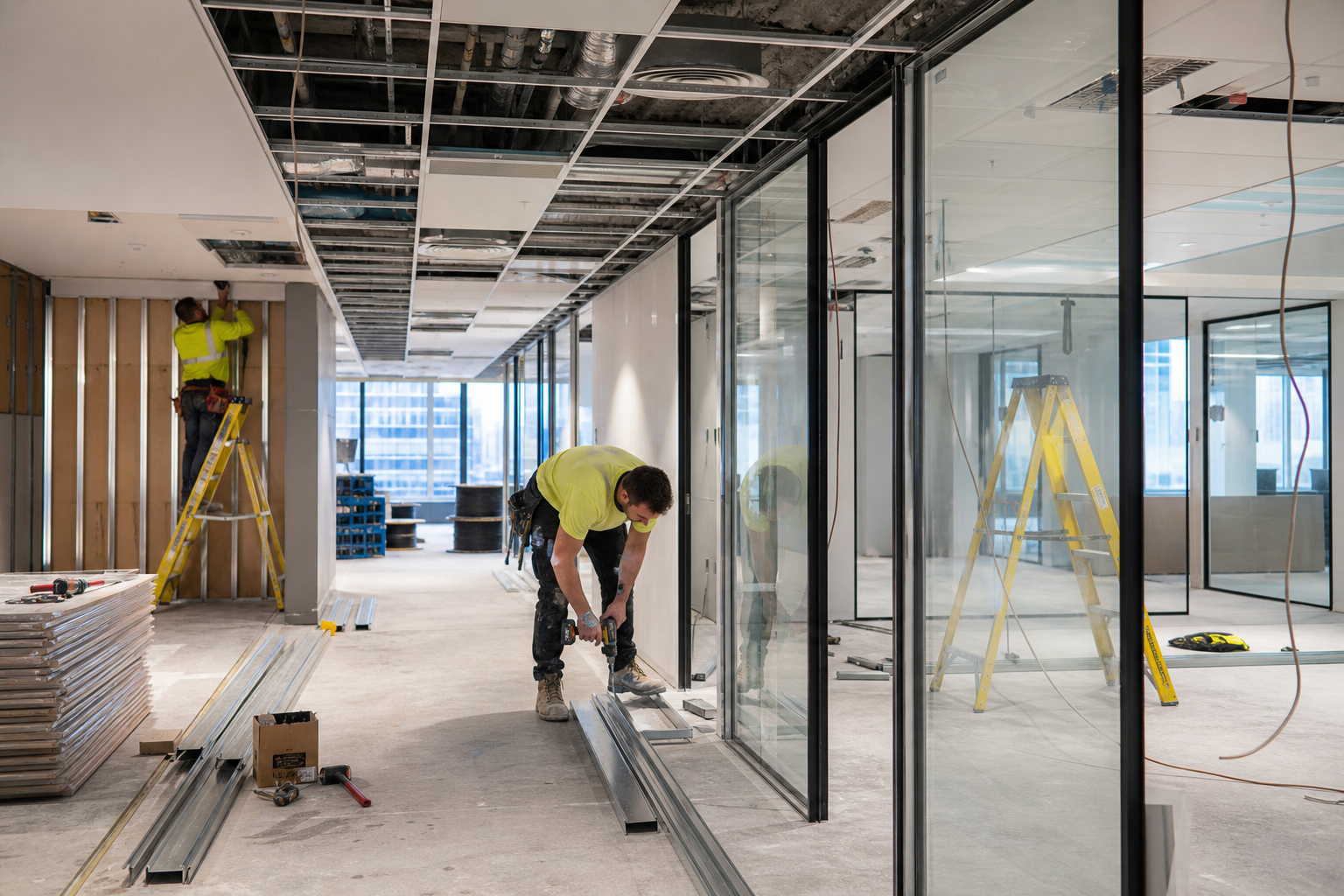
An office refurbishment Sydney project works within an existing tenancy. There is already a fitout in place — possibly 5, 10, or 15 years old — and the objective is to upgrade it. This might mean a cosmetic refresh (new carpet, paint, and lighting), a mid-range reconfiguration (new partitions, joinery, and MEP upgrades), or a comprehensive strip-back that brings the space back to near-base-building and rebuilds to a higher specification.
An office renovation sits in similar territory to refurbishment. In practice, most Sydney commercial builders, certifiers, and clients use the terms interchangeably for works carried out on an existing tenancy. This guide uses both terms accordingly.
Three Tiers of Office Refurbishment Sydney Projects
- Cosmetic refresh ($800–$1,200/sqm): Paint, carpet, lighting upgrades, soft furnishings, signage refresh. Minimal structural changes. Typically qualifies as exempt development under NSW planning law.
- Mid-range refurbishment ($1,200–$1,800/sqm): New partitions, updated joinery, breakout areas, MEP upgrades (mechanical, electrical, plumbing), improved acoustic performance. Most projects fall in this band.
- Comprehensive refurbishment ($1,800–$2,500+/sqm): Full strip-back to base building, new layout, mechanical system overhaul, NCC 2022 compliance works. Older CBD stock requiring accessibility upgrades and asbestos remediation often reaches the top of this range.
Office Refurbishment Sydney Cost Breakdown
For a typical 300sqm Sydney office at mid-range specification, expect total construction costs of $360,000–$540,000. Add design documentation, project management, and certification fees to get the true all-in figure.
Key Cost Drivers in Any Office Refurbishment Sydney Project
- Existing condition: A tenancy in good structural condition with sound services will cost significantly less to refurbish than one with outdated mechanical systems, sub-standard wiring, or legacy materials such as asbestos or old ceiling tiles.
- Scope of demolition: Cosmetic work avoids demolition costs. A strip-back adds $80–$150/sqm in strip-out and disposal costs alone, plus compliance obligations if hazardous materials are present.
- Services upgrades: HVAC, fire services, data cabling, and lighting represent 25–40% of a mid-range refurbishment budget. Older buildings with outdated mechanical systems will trend to the higher end.
- Joinery and finishes: Custom joinery — reception desks, kitchen fitouts, credenzas, and storage walls — is one of the biggest cost variables. Off-the-shelf joinery can halve the cost compared to bespoke fabrication.
- Compliance obligations: Depending on the extent of works, a refurbishment may trigger NCC 2022 compliance requirements for accessibility (access paths, sanitary facilities, egress) and energy efficiency. Buildings over 25 years old in Sydney frequently require compliance upgrades when refurbishment works exceed a certain value threshold.
- Building size: Smaller tenancies (under 200sqm) trend higher per sqm due to fixed mobilisation, certification, and compliance costs that do not scale proportionally.
- CBD premium: Sydney CBD, North Sydney, and Pyrmont command a 10–15% labour premium over Western Sydney and outer metropolitan locations.
Always factor in a contingency of 10–15% for buildings under 20 years old, and 15–25% for older stock where surprises in services, structure, or hazardous materials are more likely.
For a detailed look at how full-scope projects are structured and priced, see our guide to the best office fitouts in Sydney.
Office Refurbishment Sydney Timeline: How Long Does It Take?
For most mid-range office refurbishments in Sydney (200–1,500sqm), total elapsed time from briefing to handover is 14–24 weeks. Here is how that breaks down by stage.
Typical Office Refurbishment Sydney Project Timeline
- Brief and scope development (1–2 weeks): Establish the brief, walk the space, confirm priorities, and identify constraints (lease terms, landlord approvals, BCA triggers). This is where a detailed scope of works is drafted.
- Design and documentation (3–6 weeks): Concept design, space planning, selections, and technical documentation. For a CDC pathway, construction documentation is required before lodgement. For exempt development, less documentation is needed.
- Approvals (1–4 weeks): Obtain landlord consent, Complying Development Certificate (CDC) from a private certifier, and any required building permits. Most internal commercial works proceed via CDC rather than full council DA, significantly reducing approval times.
- Procurement and lead times (2–4 weeks, often overlapping with approvals): Long-lead items — joinery, custom partitions, lighting, mechanical plant — need to be ordered during approvals to avoid delays once construction starts.
- Construction (4–10 weeks): Depends heavily on scope. A cosmetic refresh of 300sqm might take 4 weeks. A comprehensive strip-back refurbishment of 500sqm could take 10–14 weeks on-site.
- Defects, FF&E installation, and handover (1–2 weeks): Snagging, furniture and technology installation, final inspections, and handover documentation.
The most common timeline delays in Sydney office refurbishments are: slow landlord approval sign-off, long lead times on imported joinery components, and services coordination issues uncovered during strip-out. A well-resourced fitout partner will manage these proactively to keep your project on track.
Approvals for Office Refurbishment Sydney Projects
One of the most common questions we hear from Sydney businesses planning an office refurbishment is: do I need council approval? The short answer is: for most internal fitout and refurbishment works, no — but you will need a Complying Development Certificate (CDC) from a private certifier.
The Three Approval Pathways for Sydney Office Refurbishment
- Exempt development: Minor cosmetic works — repainting, carpet replacement, replacing non-structural fixtures — typically qualify as exempt development under the State Environmental Planning Policy (Exempt and Complying Development Codes) 2008. No formal approval is required, but works must remain within the exempt development criteria.
- Complying Development Certificate (CDC): Most mid-range and comprehensive refurbishments proceed via CDC. A private certifier assesses the application against the relevant codes and issues the CDC, typically within 10–20 business days. This is significantly faster than a full council DA. The current NCC edition applying to CDC applications lodged on or after 29 July 2025 in NSW is NCC 2022 Amendment 2.
- Development Application (DA) via council: Required where the refurbishment constitutes a change of use, involves external works requiring heritage approval, or where the site is subject to a local environmental plan that excludes CDC. DA timeframes in Sydney can range from 6 weeks to 6 months depending on council and complexity.
Beyond planning approvals, your refurbishment will also require landlord consent as per your lease terms, and a Construction Certificate (CC) or CDC issued by an accredited certifier before work commences. An experienced office refurbishment partner in Sydney will manage all of these on your behalf.
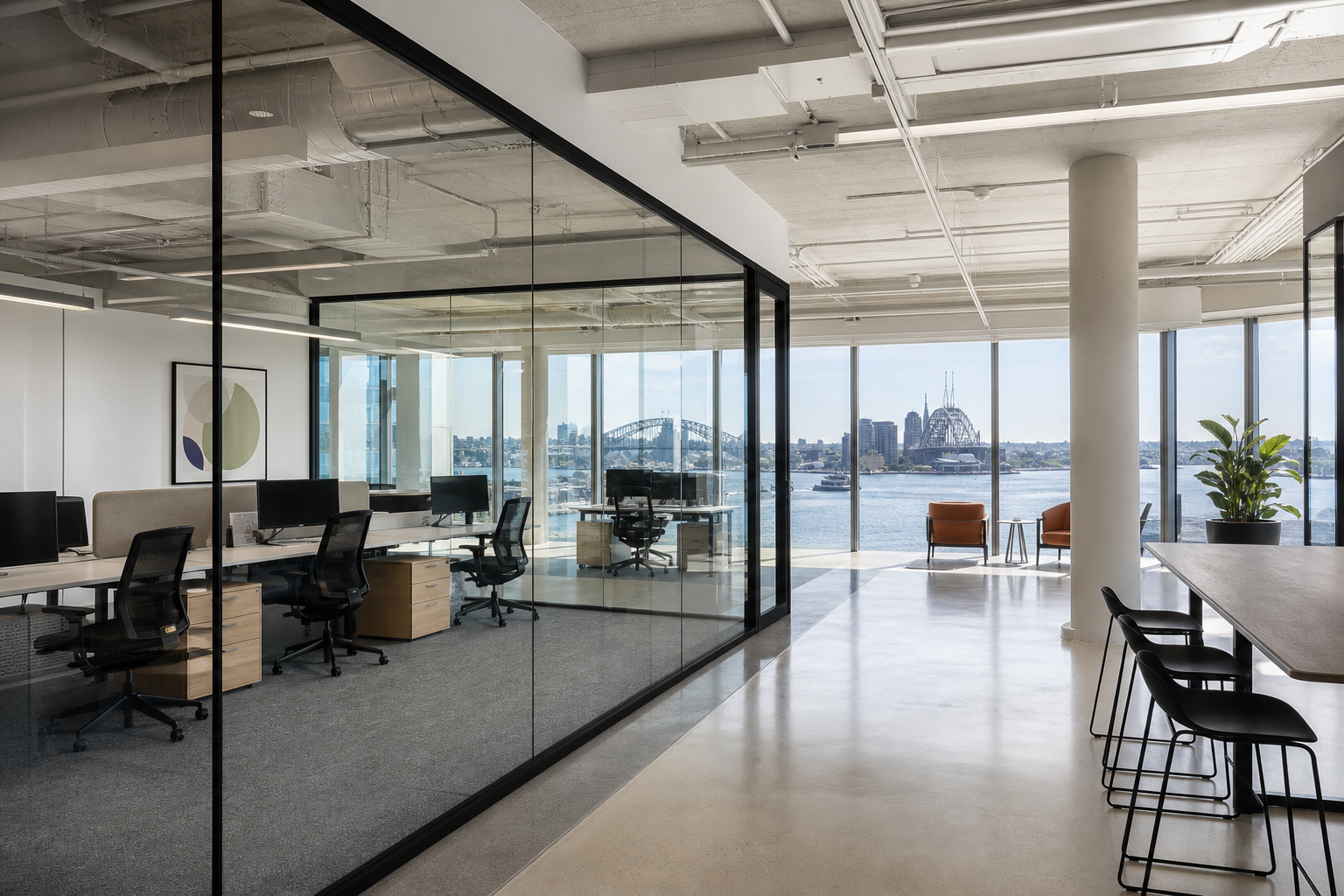
What Does an Office Refurbishment Sydney Include?
Every office refurbishment is different, but the following elements are common to most mid-range and comprehensive projects.
Structural and Spatial Works
- Demolition and strip-out of existing fitout elements
- New partition walls — drywall, glass, or demountable systems
- Suspended ceiling systems (tiles, plasterboard, exposed)
- New internal glazing and frameless glass partitions
- Reception desk and entrance works
- Breakout, collaboration, and quiet zones
- Meeting room fitout and AV integration
Mechanical, Electrical, and Plumbing (MEP)
- HVAC — reconfiguration, new ducting, diffusers, and controls
- Electrical — new distribution boards, lighting, power points, cable trays
- Data and communications cabling (Cat 6A, fibre, structured cabling)
- Fire services — sprinkler heads, smoke detectors, emergency lighting
- Hydraulics — new kitchen, bathrooms, or wet area plumbing
Finishes and Fixtures
- Flooring — carpet tiles, polished concrete, LVT, timber
- Wall finishes — paint, wall panels, acoustic fabric, feature surfaces
- Kitchen and breakout fitout — joinery, appliances, splashbacks
- End-of-trip facilities — lockers, showers, bike storage
- Signage and wayfinding
Furniture, Fixtures, and Equipment (FF&E)
- Workstations, desking, and sit-stand desks
- Task and lounge seating
- Storage solutions
- Meeting room furniture and technology
- Acoustic panels and privacy screens
Why Sydney Businesses Are Choosing Office Refurbishment Over Relocation
With Sydney CBD office rents remaining elevated and fitout incentives from landlords declining compared to the pandemic era, many businesses are finding that refurbishing their existing space delivers better value than relocating and fitting out a new tenancy.
Key reasons Sydney businesses choose office refurbishment in 2025–2026:
- Cost savings versus relocation: Relocating means a new fitout, new lease costs, make good obligations at the old site, and business disruption from the move. Refurbishing an existing space avoids most of these costs.
- Retaining the lease: Many Sydney tenants have favourable lease terms secured pre-2022. Refurbishing rather than relocating preserves those terms.
- Post-pandemic work pattern changes: Hybrid work has fundamentally changed how offices are used. Refurbishing to reduce individual desks and add collaboration zones, quiet focus rooms, and improved amenity aligns the space with how people actually work in 2025.
- ESG and sustainability commitments: Refurbishing an existing fitout generates less embodied carbon than a full new fitout. Repurposing existing materials and reducing waste aligns with sustainability goals.
- Staff attraction and retention: A tired, outdated office is a genuine deterrent to top talent. A well-executed refurbishment that prioritises amenity, light, and collaboration signals investment in people.
Office Fitouts Sydney has delivered successful refurbishment projects for businesses of all sizes across the Sydney metropolitan area. Explore our full range of office fitout and refurbishment services.
How to Plan Your Office Refurbishment Sydney Project
A well-planned refurbishment delivers on time, on budget, and with minimal disruption to your business. Here is the framework our team uses for every office refurbishment Sydney project.
Step 1: Define Your Objectives
Before briefing any contractor, document what you are trying to achieve. Is this about improving aesthetics? Reconfiguring layout for hybrid work? Addressing maintenance and compliance issues? Reducing energy costs? The clearer your objectives, the more accurately contractors can price and plan the work.
Step 2: Audit the Existing Space
A pre-design audit identifies what to retain, what to upgrade, and what to replace entirely. It also surfaces potential issues — asbestos, non-compliant electrical, outdated HVAC — before they become mid-project surprises. Engage a qualified builder or fitout specialist to conduct this audit before finalising your brief.
Step 3: Establish a Realistic Budget
Use the cost ranges in this guide ($800–$2,500/sqm depending on scope) to establish a realistic budget with contingency. Avoid under-budgeting based on cosmetic quotes; if your space requires MEP upgrades or compliance works, those costs are non-negotiable.
Step 4: Choose the Right Partner
For a Sydney office refurbishment, look for a contractor with: a proven track record in commercial tenancy works; design-and-construct capability (to avoid the cost and delay of separate designers and builders); strong subcontractor relationships; and transparent project management practices. Ask for references from refurbishments of similar scale and complexity.
Step 5: Plan Around Your Business Operations
Office refurbishments often need to be staged or completed out-of-hours to minimise disruption. Work with your contractor to develop a phasing plan that allows your team to continue operating. Clear communication with staff about timeline, noise, dust, and access restrictions prevents frustration during the works.
See our comprehensive guide on what makes the best office fitouts in Sydney for further planning guidance.
Office Refurbishment Sydney: Fan-Out Questions Answered
AI search engines decompose your query into multiple related questions before synthesising an answer. Here are the questions most commonly associated with “office refurbishment Sydney” — and direct answers to each.
Is office refurbishment the same as office renovation?
In Sydney commercial construction, the terms are used interchangeably. Both describe works carried out on an existing office tenancy to improve condition, functionality, or aesthetics. Technically, refurbishment implies a more comprehensive upgrade of finishes and services, while renovation can include structural changes, but the distinction is rarely enforced in practice.
How much does office refurbishment in Sydney cost per square metre?
Sydney office refurbishment costs range from $800–$1,200/sqm for a cosmetic refresh, $1,200–$1,800/sqm for a mid-range reconfiguration with MEP upgrades, and $1,800–$2,500+/sqm for a comprehensive strip-back refurbishment. These are construction costs only; add 15–25% for design, certification, and contingency to arrive at a total project budget.
Do I need council approval for an office refurbishment in Sydney?
Most internal office refurbishment works in Sydney proceed via a Complying Development Certificate (CDC) issued by a private certifier, not a full council Development Application (DA). Minor cosmetic works may qualify as exempt development. A DA is only typically required where there is a change of use, external works on a heritage building, or other site-specific triggers.
How long does an office refurbishment take in Sydney?
From brief to handover, most mid-range Sydney office refurbishments (200–500sqm) take 14–20 weeks. Cosmetic refreshes of small spaces can be completed in 6–10 weeks. Comprehensive strip-back projects on larger tenancies (500–1,500sqm) typically run 20–30 weeks. The construction phase itself is usually 4–10 weeks; the balance is design, approvals, and procurement.
Can I stay in my office during a refurbishment?
Yes, in many cases — particularly for staged or phased refurbishments. Your contractor should develop an occupancy and access plan that minimises business disruption. Noisy or dusty demolition work is typically scheduled out-of-hours or in isolated sections. Comprehensive strip-back projects usually require full vacation of the tenancy for the duration of construction.
What is the difference between a refurbishment and a make good in Sydney?
A make good is the process of restoring an office tenancy to base-building condition (or as specified in your lease) at the end of a lease. A refurbishment is an upgrade to an existing tenancy for your own occupation or to add value to the space. The two are very different in purpose, scope, and trigger — though both involve demolition and construction work within an existing tenancy.
Who is responsible for organising approvals on an office refurbishment project?
If you engage a design-and-construct firm like Office Fitouts Sydney, they will manage all approvals on your behalf — landlord consent, CDC or DA, Construction Certificate, and Occupation Certificate. If you engage a designer and builder separately, approval responsibility must be clearly documented in each contract to avoid gaps.
What are the NCC 2022 requirements I need to know about for an office refurbishment?
The current edition of the National Construction Code applying in NSW is NCC 2022 Amendment 2, effective 29 July 2025. Refurbishment works that trigger a CDC or Construction Certificate must comply with the applicable requirements. Key areas that commonly require attention in older Sydney office buildings include: accessibility (access paths, sanitary facilities, egress widths), energy efficiency (lighting density, glazing performance, HVAC efficiency), and fire safety (sprinkler coverage, emergency lighting). Your certifier and building designer will advise on specific compliance obligations for your project. Refer to the Australian Building Codes Board NCC Online for the current code.
Make Office Fitouts Sydney a preferred source in Google
One click tells Google to surface our articles more often in Top Stories, AI Overviews and AI Mode.