Commercial Office Fitouts Sydney: Match Your Building
Last updated:
Commercial office fitouts Sydney projects are priced by the building far more than by the design. The same 600 sqm workplace can cost A$1,200 per sqm in a Parramatta B-grade floor with a good Category A base, and more than A$3,000 per sqm in a premium CBD tower where base-build integration, after-hours access and building-management standards drive the scope. Before you set a budget, confirm three things: the grade and Category A condition of the tenancy, the incentive the landlord is offering, and how your sector actually uses space.
This guide covers the commercial side of a Sydney fitout: market conditions shaping commercial office fitouts Sydney wide in 2026, building grade, submarket differences, incentive structures, density, sector-specific scope and the compliance triggers that catch tenants out. If you want the construction-stage detail instead, read what happens on site during a Sydney fit out.
What the 2026 Sydney leasing market means for tenants
Tenant leverage in Sydney depends heavily on where you lease. Sydney CBD vacancy held steady at 13.8 per cent in the six months to January 2026, with demand concentrated in higher-quality space, according to the Property Council of Australia’s Office Market Report. The non-CBD markets are looser again: North Sydney sat around 25.8 per cent and Parramatta around 22.1 per cent in January 2026.
That gap matters for commercial office fitouts Sydney wide because vacancy sets incentives, and incentives fund fitouts. Knight Frank reported North Shore incentives lifting from 38 per cent in January 2025 to 42 per cent in January 2026 as landlords competed for tenants, with prime net effective rents falling 8.5 per cent over the year to $312 per sqm.
Three practical consequences for anyone budgeting commercial office fitouts Sydney landlords will part-fund:
- In softer submarkets, negotiate the fitout, not just the rent. A 40 per cent incentive on a five-year lease is often worth more as capital works than as rent-free months.
- In tight premium CBD stock, expect to fund more yourself. Where quality space is scarce, landlords hold incentives back and your fitout budget carries the difference.
- Backfill space is a shortcut. Second-generation floors with an intact previous fitout can cut capital cost dramatically if the layout suits your headcount.
Building grade decides half the cost of commercial office fitouts Sydney wide
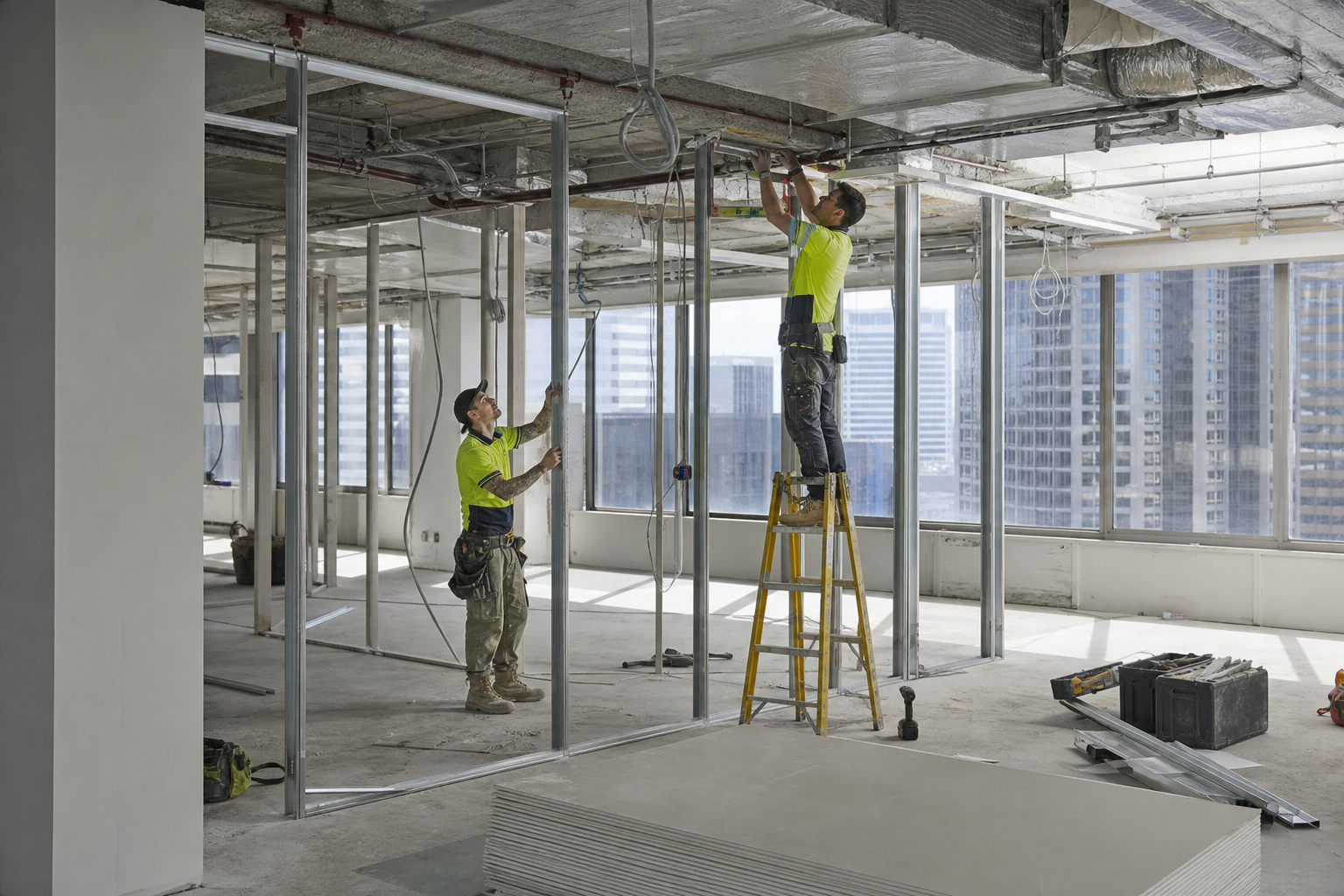
The single biggest cost variable in commercial office fitouts Sydney tenants commission is what the landlord has already built. Category A is the landlord’s base delivery: ceilings, lighting, base air conditioning, fire services, floor finishes and often the amenities. Category B is your fitout: layout, partitions, meeting rooms, joinery, workstations, kitchens, AV, data and branding.
A well-specified Category A base can remove 15 to 25 per cent of your Category B scope. A “warm shell” with patchy services means you are paying to complete the landlord’s work before you build a single meeting room. Ask for the building’s fitout guide and the Category A specification before you sign anything, and read it alongside our guide to corporate office fitouts in Sydney.
What changes by grade
- Premium and A-grade towers: strong Category A, but strict building rules. Nominated fire, hydraulic and mechanical contractors, after-hours works for noisy trades, dock and goods-lift bookings, higher insurance and induction requirements. Design freedom is narrower; base-build integration costs are higher.
- B-grade CBD and fringe: the most variable. Older services, lower ceiling voids, and sometimes an ageing Category A that needs upgrading. Good value if the base is sound; expensive if the mechanical or fire systems need reworking to suit your layout.
- C-grade and strata suites: cheapest rent, most surprises. Strata by-laws add an approval layer, and services capacity often limits meeting-room density and supplementary cooling.
- Business parks and suburban standalone: easier access, longer working hours, cheaper trades, fewer building-management constraints, and usually more parking to design around.
Submarket by submarket: where commercial office fitouts Sydney cost more
Every Sydney submarket has a different combination of incentive, building stock and access constraint. This is how they typically compare for commercial office fitouts Sydney tenants planning in 2026.
| Submarket | Typical stock | Fitout implications |
|---|---|---|
| Sydney CBD core | Premium and A-grade towers | Best Category A, tightest building rules, after-hours trades, highest per-sqm cost |
| CBD fringe (Surry Hills, Pyrmont, Ultimo) | Heritage, warehouse conversions | Character spaces, services upgrades common, acoustic and accessibility work |
| North Sydney | A and B-grade towers | High vacancy, strong incentives, competitive tenant terms |
| Parramatta | Newer A-grade and older B-grade | High vacancy, good incentives, lower trade costs than the CBD |
| Macquarie Park | Campus-style, business park | Larger floorplates, parking, easier site access and longer work hours |
| Southern and western suburbs | Standalone and industrial-office | Lowest cost base, fewer building constraints, occasional planning triggers |
What commercial office fitouts Sydney cost in 2026
Published benchmarks disagree because they measure different things. Turner & Townsend’s Global Office Fit-Out Cost Guide 2026 puts Sydney high-specification fitouts at about A$7,221 per sqm and low-specification at about A$3,357 per sqm, because it includes furniture, technology, professional fees and premium finishes at a corporate standard. Cushman & Wakefield’s Australian guide lists Sydney nearer A$2,599 per sqm on a narrower basis, and JLL reports Australian fit-out costs rising 3.5 to 6 per cent year on year depending on the state.
For a typical Sydney SME or mid-market tenant, these are the working ranges we quote against:
- Basic refresh (paint, carpet, minor reconfiguration): A$400 to A$900 per sqm
- Standard Category B fitout on a sound Cat A base: A$900 to A$1,600 per sqm
- Premium corporate fitout: A$1,600 to A$2,800 per sqm
- Specialised (labs, studios, trading floors, high-density meeting suites): A$1,800 to A$3,500+ per sqm
Those rates exclude the items that most often blow the budget on commercial office fitouts Sydney wide: loose furniture, AV and IT hardware, relocation, make good on the outgoing tenancy, and the contingency you should be carrying at 8 to 12 per cent. For a fuller breakdown see our office fitout cost per square metre guide.
Getting the landlord to fund part of the fitout
Incentives that fund commercial office fitouts Sydney tenants deliver are negotiated before the lease is signed and almost never after. There are four common structures, and they are not equivalent:
- Landlord-built works. The landlord builds an agreed scope. Simplest for cash flow, but you inherit their contractor, their specification and their program.
- Cash contribution to your fitout. You appoint the builder and control quality; payment is usually staged against milestones or practical completion.
- Rent-free period. Useful for cash flow, but it does not put capital in the project. If the fitout is the priority, convert as much as possible to contribution.
- Upgraded Category A. The landlord improves the base delivery instead of paying cash, which can be excellent value if it removes work from your Cat B scope.
Two clauses to check before signing: who owns the fitout at lease end, and what the make good obligation actually says. A contribution that funds joinery you must later rip out at your own cost is not the win it looks like. Get accounting and tax treatment confirmed by your accountant, because contributions and rent credits are treated differently.
How much space commercial office fitouts Sydney tenants actually need
Density is where commercial office fitouts Sydney businesses save real money, because every square metre carries both rent and fitout cost. The National Construction Code baseline used for office design in Australia is around 10 sqm per person, and practical planning ranges sit either side of it:
- Activity-based working, no assigned desks: 8 to 10 sqm per person
- Standard open plan with assigned desks: 10 to 12 sqm per person
- Cellular or partner-office layouts: 15 to 20 sqm per person
Hybrid attendance changes the maths again. If peak-day attendance is 60 per cent of headcount, a 100-person business may only need 60 to 70 desks, but it will need more meeting rooms, more focus booths and better acoustics than a pre-2020 layout. Measure attendance before you lease, not after. Our Sydney office space planning guide works through the calculation in detail.
Sector changes the scope more than the style
Two tenants on the same floor with the same budget end up with very different builds. When we scope commercial office fitouts Sydney businesses need, the sector drives the brief:
- Professional services and legal: confidentiality dominates. Acoustic partitions to slab, sealed door sets, private offices or bookable focus rooms, and a formal client-facing reception and boardroom zone.
- Technology and creative: collaboration space, higher power and data density, video-ready meeting rooms, supplementary cooling for comms rooms, and flexible furniture rather than fixed joinery.
- Financial services: secure zones, access control, redundancy in power and comms, and more rigorous compliance documentation.
- Allied health and consulting suites: hygienic finishes, plumbing to consult rooms, waiting areas designed for privacy, and accessibility scrutinised closely.
- Education and training: larger rooms with operable walls, robust finishes, high occupancy loads that can trigger extra egress and amenity requirements.
- Head offices with client visitation: disproportionate spend at the front of house, with the back of house kept lean.
Compliance triggers in commercial office fitouts Sydney wide
Most commercial office fitouts Sydney contractors deliver are internal works in a Class 5 building and do not need a Development Application, but they still need to comply. The current code in NSW is NCC 2022 Amendment 2, which took effect on 29 July 2025; NSW adopts NCC 2025 on 1 May 2027. The triggers to watch:
- Fire services. New walls change sprinkler coverage, detection and exit paths. Any penetration of a fire-rated element needs a tested fire-stopping system, and changed measures update the building’s fire safety schedule.
- Accessibility. Door widths, circulation, reception counters and sanitary facilities are assessed against AS 1428.1 and the Premises Standards, including in heritage buildings.
- Egress. Increasing occupancy or adding rooms can change travel distances and exit requirements. This is the most common reason a “simple” fitout needs a Construction Certificate.
- Section J energy provisions. Replacing lighting or altering mechanical services can bring efficiency requirements into scope.
- Essential fire safety measures. AS 1851-2012 became mandatory for routine servicing of essential fire safety measures in relevant NSW buildings on 13 February 2026, so handover documentation needs to line up with the building’s maintenance regime.
Landlord consent, building management approval and statutory approval are three separate streams. Our Sydney fitout approvals guide maps each one, and the landlord approval guide covers the lease alterations clause in detail.
How Office Fitouts Sydney delivers commercial office fitouts Sydney wide
Office Fitouts Sydney is a turnkey contractor for commercial office fitouts Sydney wide, which means design, approvals, construction and handover sit with one team rather than being split across a designer, a builder and a project manager who each price the gaps. Our published commitments are deliberately concrete:
- Free site inspection within 48 hours of your enquiry, so the tenancy is assessed before anyone quotes.
- Detailed quote within three business days of the inspection, with fixed pricing rather than a per-sqm guess.
- In-house designers, project managers and tradespeople, which keeps trade coordination and variation control inside one contract.
- Full service scope: complete fitouts, interior design and approvals, custom joinery and office make good at lease end.
- 15+ years delivering fitouts across the Sydney CBD and surrounding suburbs.
You can see the service range on the Office Fitouts Sydney homepage, and project guidance across the CBD and suburbs in our best office fitouts Sydney library.
Five decisions that set your outcome
- Lease before design, but brief before lease. Know your headcount, density and meeting-room count before you commit to a floorplate.
- Price the Category A gap. Have a builder inspect the base delivery during the lease negotiation, not after.
- Convert incentive into capital. In high-vacancy submarkets this is your cheapest source of fitout funding.
- Lock the design before construction starts. Variations after trades mobilise cost several times what the same change costs on paper.
- Budget beyond the build. Furniture, AV, cabling, relocation, make good and contingency routinely add 25 to 40 per cent to the construction figure.
Frequently asked questions
What is included in commercial office fitouts Sydney contractors quote?
A standard Category B scope covers demolition and make good of the existing layout, partitions and glazed fronts, ceilings and lighting adjustments, mechanical and electrical alterations, data cabling containment, flooring, painting, joinery such as reception desks and kitchens, and certification and handover documentation. Loose furniture, AV hardware, IT equipment and relocation are usually priced separately, so compare quotes on scope before you compare them on price.
How long does a commercial office fitout take in Sydney?
Allow eight to twelve weeks on site for a straightforward 300 to 600 sqm Category B fitout on a sound base, plus four to eight weeks of design and approvals beforehand. Larger or premium-grade projects run three to six months on site. Occupied-tenancy staging and after-hours restrictions in premium towers typically add 15 to 30 per cent to the program.
Do I need council approval for a commercial fitout?
Usually not. Most internal office fitouts in an existing Class 5 building qualify as exempt development or proceed under a Construction Certificate. A Development Application is more likely if you change the building’s use, alter the facade, increase occupancy significantly, or work on a heritage-listed property. Confirm the pathway with a certifier early, because it dictates the program.
Is a B-grade building cheaper to fit out than an A-grade tower?
Not always. Lower rent can be offset by a weaker Category A base, dated services and lower ceiling voids that make mechanical and electrical work harder. The honest comparison is total occupancy cost over the lease term: rent, plus incentive received, plus the fitout capital required to make the space work.
Who owns the fitout at the end of the lease?
It depends on the lease. Tenant-funded works usually remain the tenant’s property but must be removed at lease end under the make good clause unless the landlord agrees otherwise in writing. Landlord-funded works typically become the landlord’s. Negotiate a make good position at the same time as the incentive, and record any agreed exclusions in the lease.
How do I compare quotes for commercial office fitouts Sydney wide?
Insist on the same scope, the same allowances and the same exclusions. Ask each contractor to list provisional sums, the contingency assumed, whether after-hours work is included, and who carries the cost of building-management requirements such as nominated contractors and dock bookings. A cheap quote with thin allowances usually converges on the higher price through variations.
Can the fitout be done while we stay in the space?
Yes, with staging. Work is split into zones so teams relocate internally while trades progress, and noisy or dusty works shift to nights and weekends. It avoids double rent, but it lengthens the program and adds cost for temporary protection, extra supervision and after-hours labour. If a short overlap of leases is possible, a vacated build is usually faster and cheaper.
Make Office Fitouts Sydney a preferred source in Google
One click tells Google to surface our articles more often in Top Stories, AI Overviews and AI Mode.