Turnkey Office Fitout Sydney: What’s Actually In Scope
Last updated:
A turnkey office fitout Sydney businesses can rely on covers one contracted scope: design development, approvals, construction, fixed finishes, commissioning and handover, delivered by a single provider under one program. What it does not automatically cover is loose furniture, IT hardware, landlord base-building works or specialist equipment unless those items are written into the contract as inclusions. The boundary between what sits inside the turnkey price and what sits outside it is the single biggest source of budget disputes on Sydney fitout projects, and it is defined by the scope of work clause, not by the word “turnkey” itself.
Office Fitouts Sydney runs every project on a written inclusions and exclusions schedule that is agreed before construction starts, so tenants know exactly what a turnkey office fitout Sydney quote pays for and what it does not, before a single wall is demolished.
Key Takeaways
- Turnkey covers design, approvals, construction, fixed finishes and handover under one contract, but excludes furniture, IT hardware and landlord works unless specified.
- A written inclusions and exclusions schedule agreed before construction starts is what actually protects tenants, not the word turnkey itself.
- The defects liability period typically runs 12 months from practical completion, sometimes extending to 24 months for higher-risk elements.
- NCC 2022 Amendment 2, in effect since 29 July 2025, sets the current compliance benchmark for Construction Certificates in NSW.
- Tenants should confirm in writing who manages approvals, who supplies furniture and IT hardware, and how retention is released.
What “Turnkey” Actually Means in a Sydney Office Fitout Contract
Turnkey describes who is accountable for coordinating the work, not how much work is done. A fitout can be identical in scope, delivered under a traditional model with separate contracts for design, project management and construction, or under a turnkey model where one provider holds all three. The visible result can look the same from the tenant’s side. What differs is the accountability chain: in a turnkey engagement, one contract, one program and one point of contact carries the risk of coordinating every trade.
This distinction matters because “complete fitout” and “turnkey fitout” get used interchangeably, and they answer different questions. Complete describes the breadth of work covered. Turnkey describes who is responsible for making that work land as one finished, operational space on the handover date. A tenant comparing a turnkey office fitout Sydney quote against a project-managed alternative should be comparing accountability structures, not assuming the scope is identical by default.
The Core Scope Every Turnkey Office Fitout Sydney Project Should Include
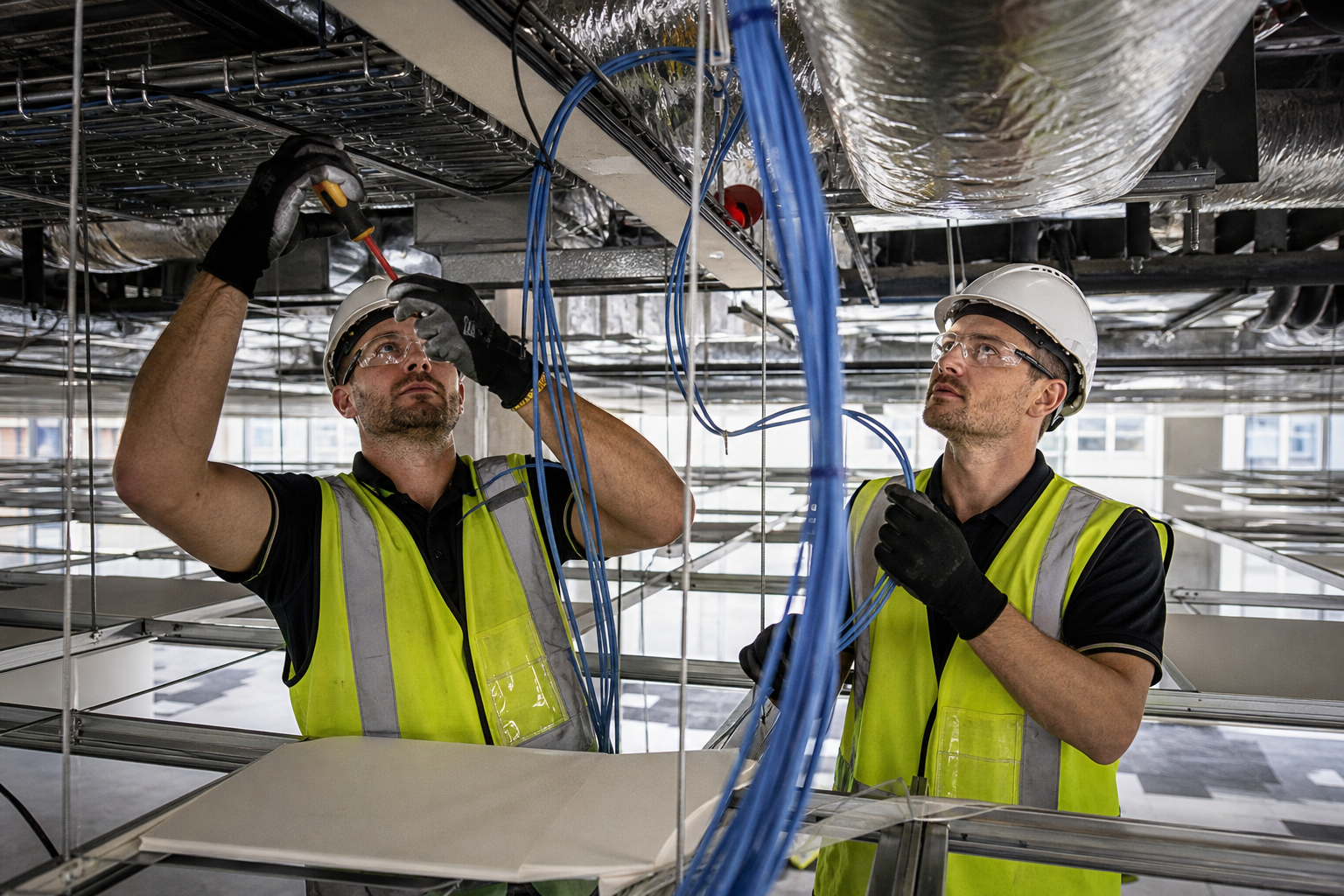
Across the projects Office Fitouts Sydney delivers, a properly specified turnkey scope runs from site survey through to final handover documentation. At minimum it should include:
- Site survey, measure and base-building condition report
- Design development, working drawings and finishes specification
- Development approval or Complying Development Certificate pathway assessment, and Construction Certificate documentation where required
- Demolition and strip-out of the existing tenancy
- Partitioning, ceilings, flooring and painting
- Electrical, data cabling, and lighting design and installation
- Mechanical services adjustment for the new floor plan (ventilation, air-conditioning zoning)
- Fire services coordination: sprinkler relocation, smoke detection, egress paths, exit signage
- Custom joinery: reception desks, kitchenettes, storage walls, meeting room cabinetry
- Glass partitioning and manifestation
- Signage and branding application
- Quality inspections, defect rectification (the “snag list”), and final handover documentation
Each of these trades has to be sequenced against the others, not delivered in isolation. A fire services relocation that doesn’t line up with a revised ceiling grid, or data cabling installed before partition framing is finalised, creates rework that a single-provider program is specifically designed to prevent. This is the practical value a properly run turnkey office fitout Sydney program is meant to deliver: fewer handoffs between consultants, and one team accountable for the sequencing.
What Usually Sits Outside a Turnkey Office Fitout Sydney Scope
The items most commonly assumed to be included, and most commonly excluded unless the tenant specifies otherwise, are:
- Loose furniture – workstations, chairs, meeting tables and soft seating are frequently procured as a separate line item, even inside a “turnkey” engagement, because lead times and supplier relationships differ from construction trades.
- IT and AV hardware – network switches, conference room displays, cameras and access control systems are often supplied and configured by the tenant’s own IT provider, with the fitout contractor only responsible for the containment and cabling pathways.
- Landlord base-building works – anything touching shared services, structural elements, or common property (lift lobbies, fire stairs, base-building risers) usually requires separate landlord sign-off and, in many leases, a separate landlord-appointed contractor.
- Specialist equipment – server racks, medical or laboratory equipment, kitchen appliances beyond a standard kitchenette, and security systems tied to a head-office standard.
- Make good obligations on the outgoing tenancy – restoring a previous space to base building condition is a separate scope and a separate contract line, even when the same provider is engaged for both.
None of this makes turnkey a misleading term. It means the word describes the delivery model, and the schedule of inclusions and exclusions still has to be read line by line before signing. On a well-scoped turnkey office fitout Sydney project, these boundaries are agreed and priced before construction starts, not renegotiated once trades are already on site.
Why the Inclusions and Exclusions Schedule Matters More Than the Headline Price
The Sprintlaw guide to office fitout scope of work clauses for Australian projects lists the three mistakes that recur across disputed fitout contracts: broad descriptions like “complete fitout works” with no itemised deliverables, failing to separate inclusions from exclusions and assumptions, and accepting standard contract terms before checking how variations, delays and defects interact with the agreed scope. Sprintlaw’s guidance is aimed at businesses drafting or reviewing these clauses themselves, and it applies directly to a turnkey office fitout Sydney contract: the price only means something once it is tied to a specific, itemised list of what that price buys.
A scope schedule that avoids ambiguity states, for every trade line, whether it is included, excluded, or an assumption that changes the price if it proves wrong. It names who obtains approvals and who carries the risk of an approval delay. It states whether the engagement is design-only, construct-only, or design and construct. And it lists who supplies loose furniture, workstation selections and specialist equipment, because that answer changes the total project cost by a meaningful margin on most Sydney office projects.
Single Point of Responsibility on a Turnkey Office Fitout Sydney Project
The commercial reason tenants choose turnkey delivery is single point of responsibility. If a data outlet is installed in the wrong location, or a partition doesn’t align with the ceiling grid, the tenant has one contract to enforce and one program to hold accountable, rather than trying to establish which of three separate consultants is responsible for the mismatch. That coordination value is real, but it only holds if the scope of work was specific enough at signing to define what “correct” looks like for each trade.
Where the tenant’s brief is still evolving, a traditional model, with design running ahead of construction under separate contracts, can actually reduce risk, because it lets the brief get reworked without burning against a fixed turnkey program. Turnkey performs best when the tenant can describe the outcome clearly enough for one provider to price and sequence it with confidence.
Practical Completion and the Defects Liability Period
A turnkey program does not end at handover. Practical completion under standard Australian commercial contract forms (AS 4000, AS 2124, AS 4300) triggers the start of the defects liability period, the transfer of possession, and the release of the first tranche of any retention held against the contractor. On most commercial fitout contracts the defects liability period runs 12 months from practical completion, occasionally extending to 24 months for larger or higher-risk elements.
During that window the contractor remains obliged to return and rectify defects in workmanship at no additional cost to the tenant. A well-run turnkey program schedules a closeout walkthrough four to six weeks before the defects liability period expires, not on the day it ends, because any item raised at the walkthrough still needs time to be programmed and rectified before the contractual window closes. As one Australian defects-liability guide notes, there is no single statutory figure for this period nationally; it is set entirely by the contract, which is exactly why the number needs to be confirmed in writing before a turnkey office fitout Sydney contract is signed, not assumed from habit.
Approvals: What a Turnkey Provider Should Be Managing
In NSW, most office tenancies sit within a Class 5 part of a building under the National Construction Code, though classification has to be confirmed for each specific tenancy. The current code is NCC 2022 Amendment 2, in effect since 29 July 2025, which sets minimum performance requirements for fire safety, access and egress, accessibility, health, amenity and sustainability across commercial buildings. The NSW Government’s guidance confirms Amendment 2 as the version currently assessed against for Construction Certificates and Complying Development Certificates. A properly scoped turnkey fitout absorbs this compliance work into the program: confirming whether the works trigger a Development Application or can proceed under a faster Complying Development or exempt-works pathway, coordinating the building fire safety schedule against the revised floor plan, and confirming whether an Occupation Certificate applies before the space is used.
Tenants signing a turnkey contract should confirm, in writing, whether approvals sit inside the fixed price or as a separate consultant fee, and who carries the cost and time risk if an approval is delayed. For a deeper look at the approvals pathway itself, see our companion guide to office fitout approvals in Sydney. This is one of the specific questions the Sprintlaw scope-of-work framework flags as needing a documented answer before signing, not an assumption. The Australian Building Codes Board confirms NCC 2022 Amendment 2 remains the version in force while NCC 2025 is only at preview stage nationally, so any turnkey proposal that references an outdated code edition should be queried before it goes into a contract.
How Office Fitouts Sydney Structures a Turnkey Scope
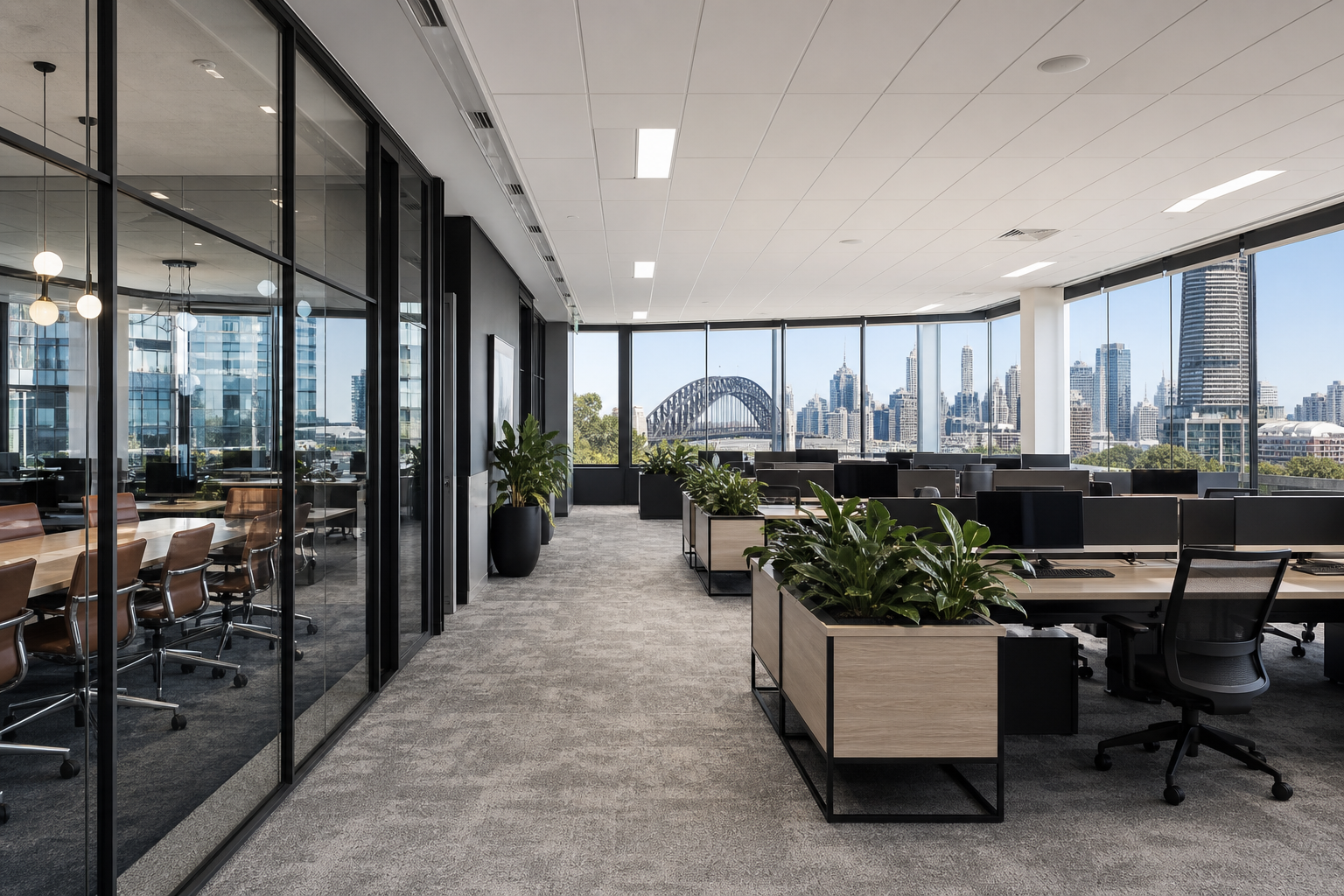
Office Fitouts Sydney issues a written inclusions and exclusions schedule with every turnkey office fitout Sydney proposal, tied line by line to the construction drawings and specification, before any contract is signed. That schedule states plainly what construction trades, approvals, and services are covered by the fixed price, and separately lists furniture, IT hardware and any landlord-controlled works so the tenant can budget for them without surprise. Our in-house design, project management and construction teams operate under that single schedule, which is what keeps a genuinely single-provider model accountable rather than becoming three separate teams that happen to share an invoice.
For a full breakdown of how our own delivery model compares against project-managed and design-and-build alternatives, see our guide to choosing the right office fitout approach in Sydney, or start with our overview of office fitout services across Sydney.
A Practical Checklist Before Signing a Turnkey Office Fitout Sydney Contract
- Ask for a written inclusions and exclusions schedule tied to the drawings, not a one-line “complete fitout” description.
- Confirm whether furniture, IT hardware and specialist equipment are included in the fixed price or quoted separately.
- Confirm who is responsible for approvals, and who carries the cost if an approval is delayed.
- Confirm the defects liability period length and when the closeout walkthrough will be scheduled.
- Confirm whether landlord base-building works fall inside or outside the turnkey scope.
- Check that the program sequences fire services, ceilings, partitions, and data cabling in a logical, non-conflicting order.
- Confirm what happens to retention: how much is released at practical completion versus at the end of the defects liability period.
Whats typically included vs excluded in a turnkey office fitout Sydney scope?
| Category | Usually Included | Usually Excluded (unless specified) |
|---|---|---|
| Construction trades | Partitioning, ceilings, flooring, painting, electrical, data cabling, lighting, mechanical services, fire services | Landlord base-building works (lift lobbies, fire stairs, risers) |
| Design and approvals | Design development, working drawings, DA/CDC pathway assessment, Construction Certificate documentation | Approvals may sit as separate consultant fee if not stated in writing |
| Fixtures and finishes | Custom joinery, glass partitioning, signage and branding, finishes specification | Specialist equipment: server racks, medical/lab equipment, kitchen appliances beyond kitchenette |
| Equipment and furniture | Containment and cabling pathways for IT/AV | Loose furniture (workstations, chairs, tables), IT/AV hardware itself |
| Handover and post-completion | Quality inspections, defect rectification, handover documentation, defects liability period coverage | Make good obligations on outgoing tenancy (separate contract line) |
Frequently Asked Questions
Does a turnkey office fitout Sydney contract include furniture?
Not automatically. Loose furniture such as workstations, chairs and meeting tables is often quoted as a separate line item even within a turnkey engagement, because furniture lead times and supplier relationships differ from construction trades. Confirm this in the written scope before signing.
What is the difference between a turnkey fitout and a complete fitout?
A complete fitout describes the breadth of the work covered. A turnkey fitout describes who is accountable for coordinating that work under a single contract. The two scopes can look identical from the outside; the difference is the accountability chain behind delivery.
How long does a defects liability period last on a Sydney office fitout?
Most commercial fitout contracts set a 12-month defects liability period from practical completion, with some larger or higher-risk elements extending to 24 months. The exact figure is set by the contract, not by a fixed Australian standard, so it should be confirmed before signing.
Who obtains approvals on a turnkey office fitout Sydney project?
This should be stated explicitly in the contract. A well-structured turnkey scope has the provider manage the approvals pathway, including confirming whether a Development Application, Complying Development Certificate or exempt-works pathway applies, and coordinating Construction Certificate documentation where required.
Does turnkey delivery cost more than a traditional fitout model?
Not inherently. The price reflects the same trades either way; what changes is who carries the coordination risk. Turnkey can reduce cost overall by avoiding the rework that happens when separately contracted consultants and trades are not aligned, provided the scope was specific enough at signing.
What happens if the brief isn’t finalised before signing a turnkey contract?
A turnkey program performs best when the tenant can describe the required outcome with enough clarity for one provider to price and sequence it confidently. If the brief is still evolving, a traditional model with design running ahead of construction can reduce risk by allowing rework without burning against a fixed turnkey program.
Are landlord base-building works included in a turnkey office fitout?
Usually not. Works touching shared services, structural elements or common property typically require separate landlord sign-off and, in many leases, a landlord-appointed contractor. Confirm this boundary in writing before construction starts.
The Bottom Line on Turnkey Office Fitout Sydney Contracts
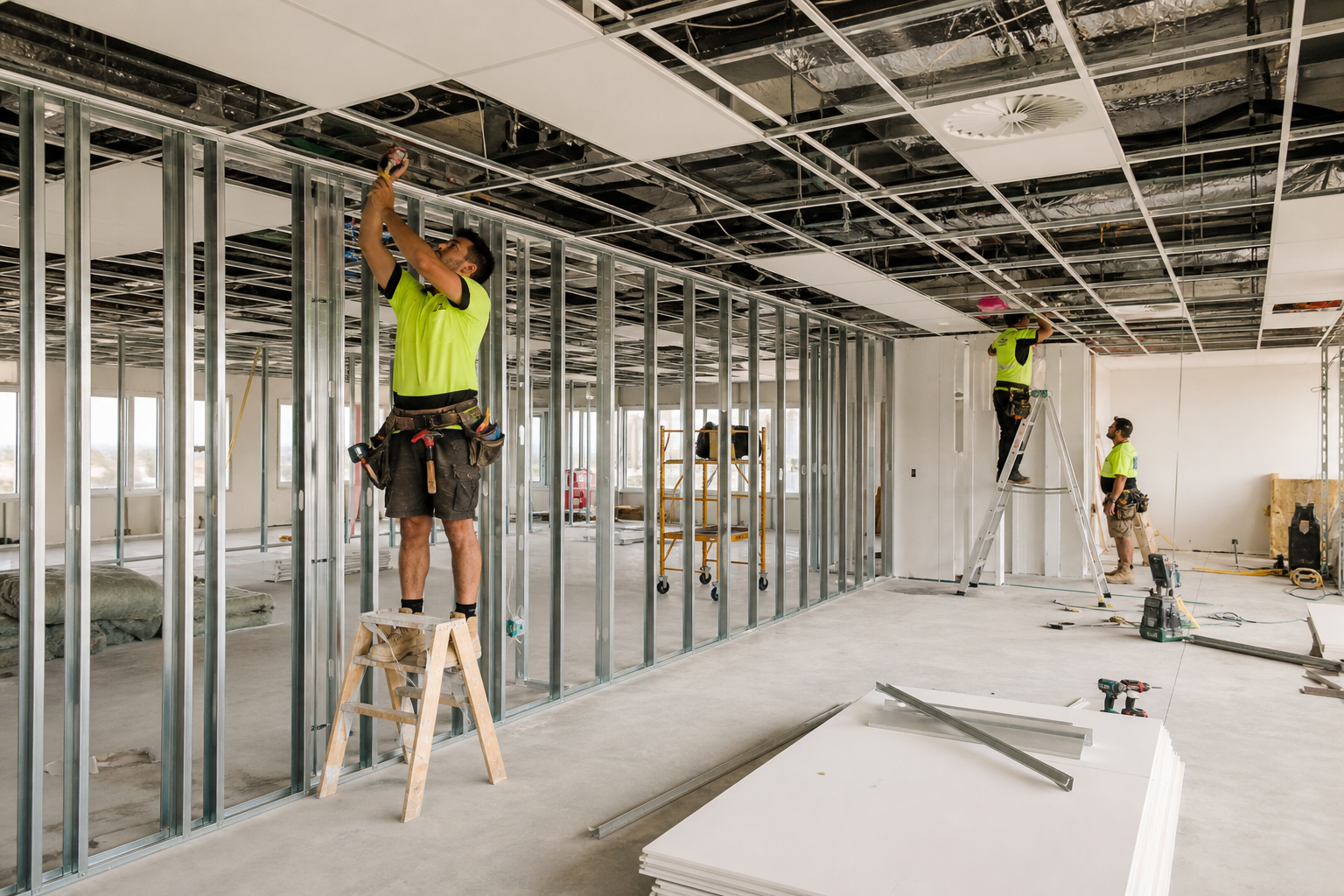
A genuine turnkey office fitout Sydney contract is defined by two things: a single point of accountability for coordinating every trade, and a written inclusions and exclusions schedule specific enough to price the job correctly. The word “turnkey” on its own guarantees neither breadth of scope nor cost certainty. Tenants get both only when the schedule of works is itemised against the drawings, when furniture and IT hardware responsibility is stated plainly, and when the defects liability period and approvals process are agreed before the contract is signed.
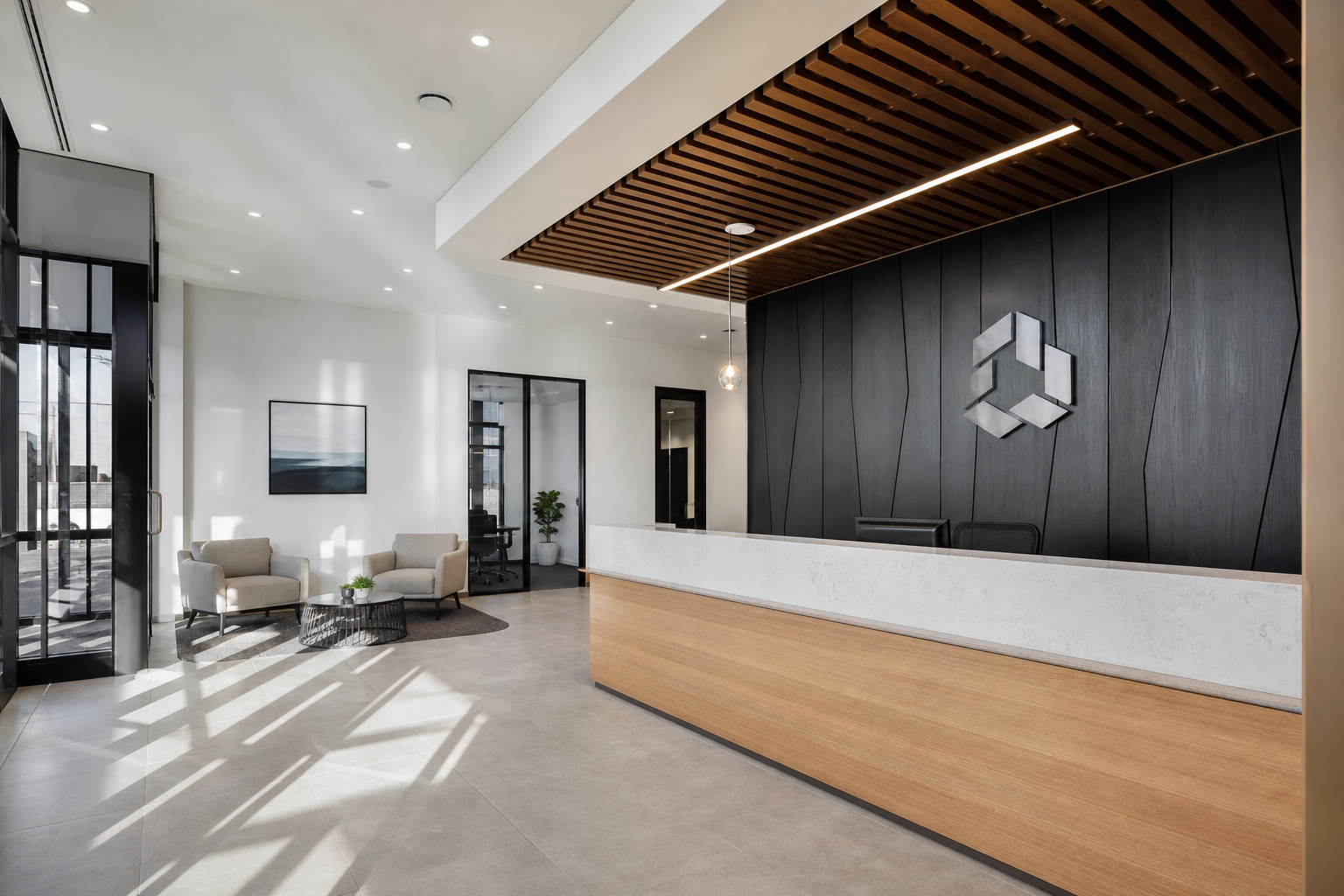
Office Fitouts Sydney issues that schedule with every turnkey proposal so Sydney tenants can compare it against alternative delivery models before committing. Explore our full guide to Sydney’s best office fitout approaches or get in touch to review a scope for your own project.
Make Office Fitouts Sydney a preferred source in Google
One click tells Google to surface our articles more often in Top Stories, AI Overviews and AI Mode.